
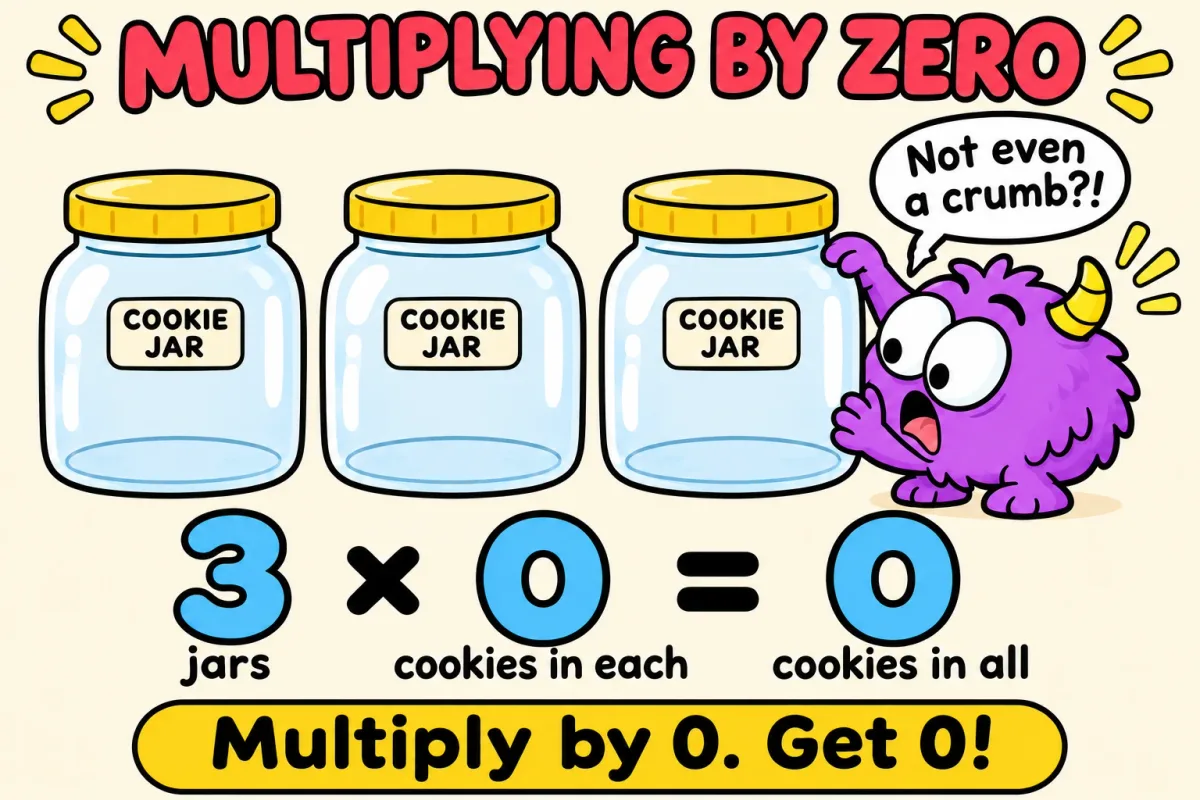
Why does the 0 rule help me?
Some multiplication problems have a 0 in them, like 8 × 0 or 0 × 6. They look hard. They are the easiest ones. When you know the 0 rule, you know the answer at once. You do not need to count. First, see why the rule is true.
What does 3 × 0 mean?
3 × 0 means 3 trays with 0 cookies on each tray. To see it, start with 2 cookies on each tray. Press Take away 1 cookie from each tray. Watch the numbers change.
Three trays of cookies
3 trays. 2 cookies on each tray.
Check the explanation and answers
Start with 3 trays and 2 cookies on each tray: 2 + 2 + 2 = 6, so 3 × 2 = 6. Take away 1 cookie from each tray: 1 + 1 + 1 = 3, so 3 × 1 = 3. One more cookie leaves each tray. Now every tray is empty: 0 + 0 + 0 = 0, so 3 × 0 = 0. For the empty trays, the answers are 3 trays, 0 in each tray, and 0 in total. If you take away 1 tray at a time, whole trays leave: 2 × 2 = 4, then 1 × 2 = 2, then 0 × 2 = 0.
The 3 trays are still there. But they are empty, so there are no cookies to count.
Does it matter how many baskets or boxes are empty?
Try it with 5 baskets. Then try it with 8 crayon boxes.

Five empty baskets
There are 5 baskets. Each basket has 0 apples. How many apples are there in all?
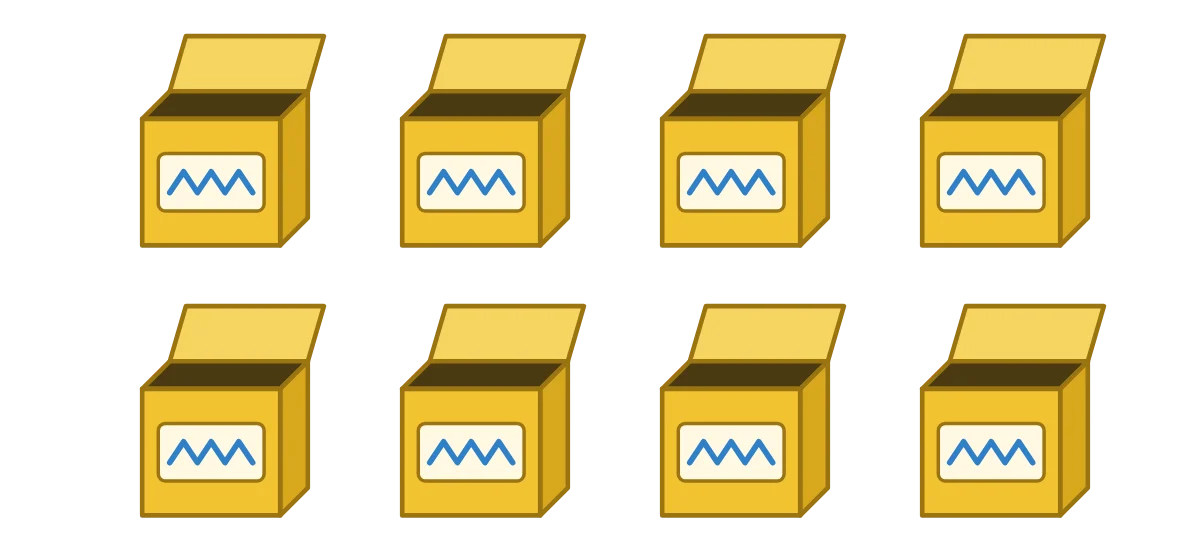
Eight empty crayon boxes
There are 8 crayon boxes. Each box has 0 crayons. How many crayons are there in all?
Empty is empty. It does not matter how many baskets or boxes are empty. There is still nothing to count.
What does 0 × 4 mean?
Now the 0 comes first. 0 × 4 means 0 trays with 4 cookies on each tray. Start with 2 trays. Press Take away 1 tray. One whole tray leaves. Watch the numbers change.
Two trays of 4 cookies
2 trays. 4 cookies on each tray.
Check the explanation and answers
Start with 2 trays and 4 cookies on each tray: 4 + 4 = 8, so 2 × 4 = 8. Take away 1 tray. One tray of 4 cookies is left: 1 × 4 = 4. The last tray leaves. No trays are left, so no cookies are left: 0 × 4 = 0. For no trays, the answers are 0 trays, 4 in each tray, and 0 in total. If you take away 1 cookie from each tray, the 2 trays stay and the cookies leave: 2 × 3 = 6, 2 × 2 = 4, 2 × 1 = 2, then 2 × 0 = 0.
No trays means no cookies. It does not matter that each tray holds 4.
What is the zero property of multiplication?
Any number times 0 is 0. And 0 times any number is 0. This rule is the zero property of multiplication. You can say it this way: empty groups make 0, and no groups make 0.
The rule works for every number, small or big: 9 × 0 = 0, 0 × 25 = 0, and 1,000 × 0 = 0.
How is multiplying by 0 different from multiplying by 1?
Do not mix up 0 and 1. Look at 1 basket of 5 apples.
One basket of 5 apples
1 basket of 5 apples.
Check the explanation and answers
There is 1 basket with 5 apples: 1 × 5 = 5. One group keeps the number. With 0 baskets there are no apples: 0 × 5 = 0.
Times 1 means one group. You keep the number: 1 × 5 = 5.
Times 0 means no groups, or empty groups. You get 0: 0 × 5 = 0.
To learn why times 1 keeps the number, see the identity property of multiplication.
Can I use the 0 rule with new numbers?
Try these 3 problems. Read each one with care. One of them does not have a 0.
Six nests
A farmer looks in 6 nests. Each nest has 0 eggs. How many eggs does the farmer find?
Pots of 9 seedlings
A shop puts 9 seedlings in each pot. You take home 0 pots. How many seedlings do you take home?
One pot of 9 seedlings
Now you take home 1 pot with 9 seedlings. How many seedlings do you take home?
Why is 5 × 0 not 5?
A common mistake is 5 × 0 = 5. Think of 5 baskets with 0 apples in each basket. The 5 counts the baskets. It does not count apples. There are no apples, so 5 × 0 = 0.
Adding 0 is different. 5 + 0 = 5, because you add nothing to 5. Multiplying by 0 gives 0.
Where can I get a zero property worksheet with answers?
Print 8 questions: empty trays and baskets to count, a table with no trays, quick facts, facts with 0 and 1, a mistake to fix, a picture to draw, and a story problem. Each PDF has a student page and a separate answer key.
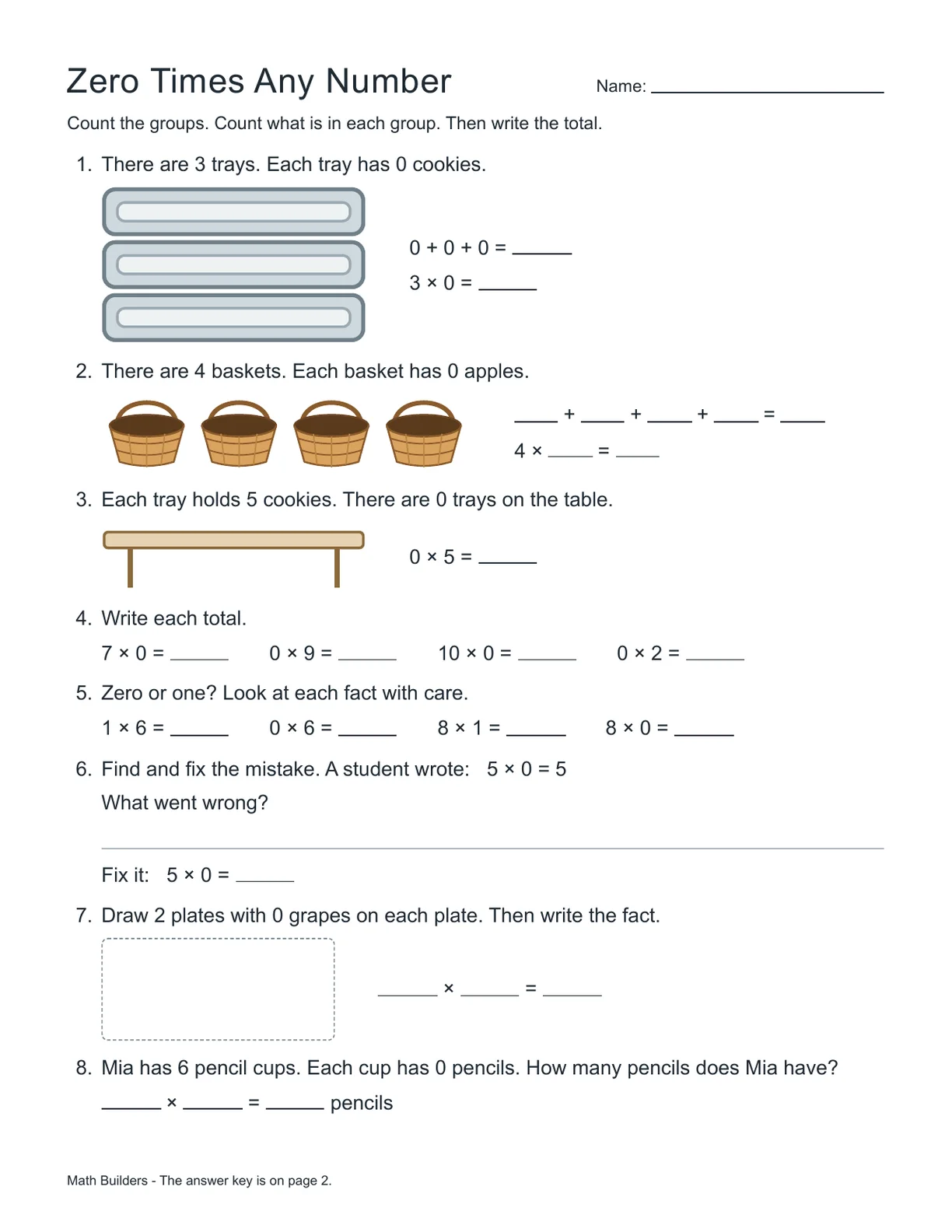
Download the worksheet and answer key (US Letter PDF)
Download the worksheet and answer key (A4 PDF)
Print at actual size. Try all 8 questions first, then check your work with the answer key.
Plan short multiplication practice
Use the Math Builders quiz to plan practice for your child or class.
Notes for parents and teachers
Start with real objects. Put out 3 plates with 2 crackers on each plate. Ask three questions: How many plates? How many on each plate? How many in all? Take 1 cracker from each plate and ask again. Do it one more time, so that the plates are empty.
Then teach the other meaning. Put out 2 plates of 4 crackers and take away whole plates. Many children find 0 × 4 harder than 4 × 0, because there is nothing to look at. Say the full phrase each time: 0 plates of 4.
Let your child say the rule in their own words before you name it. The term zero property of multiplication can come later. If your child writes 5 × 0 = 5, ask what the 5 counts. This lesson is about multiplication only. Division by 0 is a different topic and has no answer.
Review equal rows in multiplication arrays, or connect facts with multiplication and division fact families. For short recall practice, go back to the multiplication fact fluency guide.
More rules of multiplication: the distributive property of multiplication and the identity property of multiplication.
Teaching connections: Common Core 3.OA.A.1 and 3.OA.D.9. This lesson supports work with equal groups and with patterns in multiplication.