
What TTRS Is Built to Do
TTRS is a whole-school times tables platform. Its official school positioning leans into adaptive games, avatars, teacher statistics, inter-school competitions, assemblies, and an energetic classroom culture around multiplication and division recall.
That is useful when a school wants buzz. It is not always what a single learner needs after dinner, during homeschool math, or in a quiet intervention block. The alternative question is not "which product is louder?" It is "which routine will this learner actually repeat tomorrow?"
Where Math Builders Is Different
- Short sessions by default
Practice is designed around 2-to-5-minute sessions, not a long game block that has to become the main activity.
- Slow facts stay in view
Facts answered slowly or incorrectly keep returning. Mastery means quick recall that survives later review.
- Timer stays visible, feedback stays calm
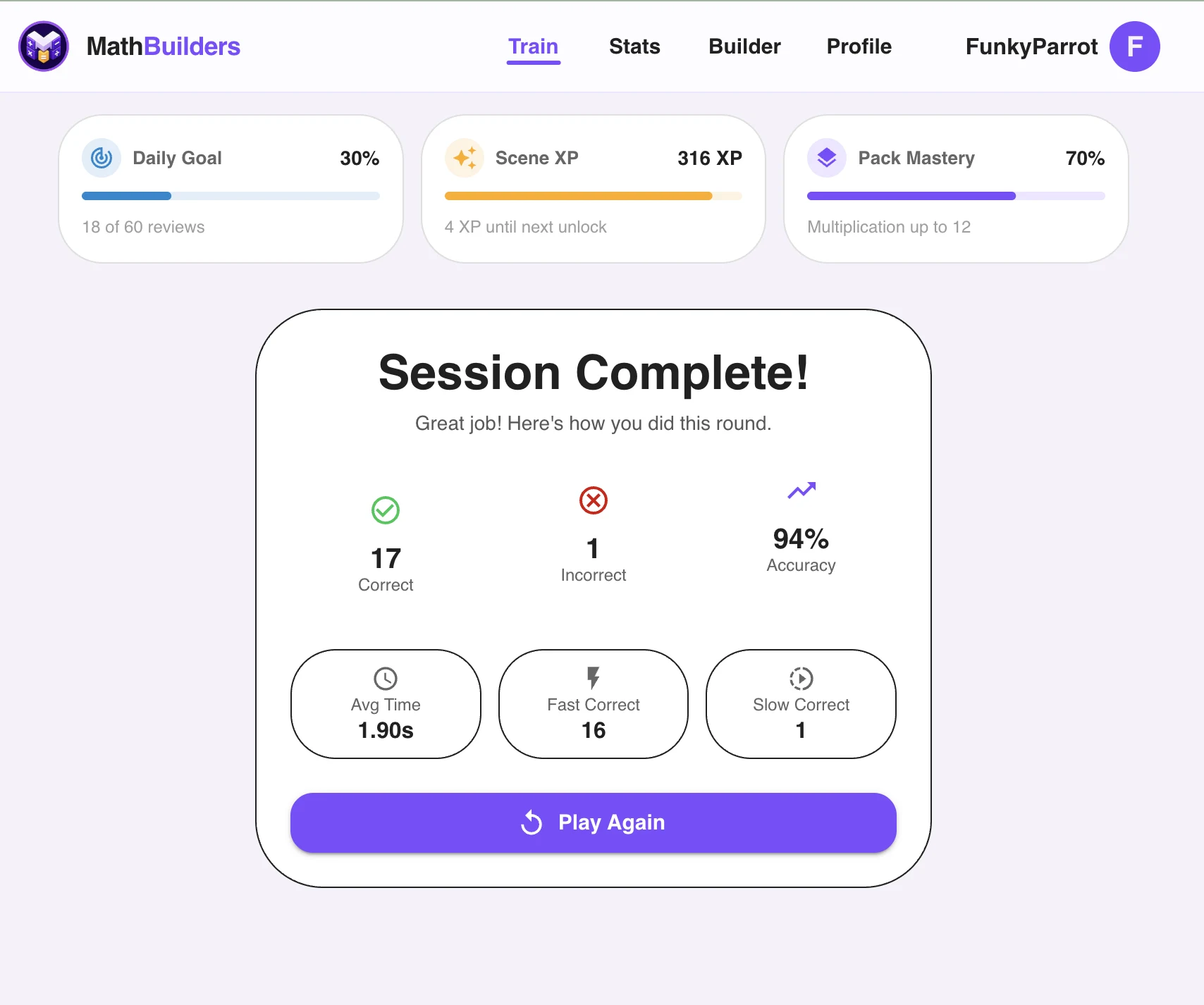
Every session shows a countdown timer and a quiet checkmark after each correct answer. The feedback is visible, but it is not a public leaderboard race.
- Reporting shows the weak facts
The Stats page shows most missed facts across All Time and This Week views, plus lifetime sessions, questions, accuracy, mastery, and due-card stats.
- Custom flash-card backgrounds
Learners can build saved scenes in the Builder and use them as the background behind their fact cards.
Side-by-Side Fit
| Need | Times Tables Rock Stars fit | Math Builders fit |
|---|---|---|
| Best use case | Whole-school culture, classroom events, competitions, and teacher-managed practice | Home, homeschool, tutoring, or small-group fluency practice |
| Session feel | Game modes, avatar rewards, leaderboard energy, and a rock theme | Quiet recall loop with a clear start, clear stop, and a short daily target |
| Pressure model | Includes accessibility controls such as hiding the timer or decluttering the screen | Prominent countdown timer and calm answer feedback, without a public leaderboard race |
| Weak-fact review | Adaptive question-based games | Slow and missed facts return with spaced repetition until recall holds |
| Customization and reporting | Avatars, game modes, rewards, and teacher statistics | Builder-made flash-card backgrounds plus Most Missed Facts reports for All Time and This Week |
| When to choose it | You want a full classroom program and the competitive theme motivates your learners | You want a calmer fluency layer that is easy to repeat daily |
This comparison is about fit, not a claim that one tool should replace the other in every setting.
Calm MTC Practice Checklist
The Multiplication Tables Check rewards quick recall. That does not mean daily practice has to feel like a public race. Use this checklist when a child needs MTC-style speed practice, but leaderboards, tournaments, or a whole-session race make the routine harder to repeat.
Timing
- Does practice check speed per fact instead of one big countdown over the whole session?
- If a fact is slow, does it come back later instead of being marked done?
- Can the child stop after a short session without losing the whole run?
Pressure
- Can progress stay private?
- Are leaderboards, tournaments, and class rankings optional instead of the main motivation?
- Would an anxious learner know what to work on next without feeling publicly ranked?
Targeting
- Does the routine spend more time on facts that were missed or slow?
- Does practice get narrower over time instead of giving every fact equal attention forever?
- Does it separate eventually correct from fluent enough for bigger math?
Daily fit
- Can the routine fit into 2 to 5 minutes?
- Can a parent, tutor, or teacher see enough progress to know whether the child is improving?
- Does it help with MTC-style recall without making every session feel like the official check?
The calmer version still uses timing. Known facts should become quick, often around three seconds. The difference is where the pressure lives: per-fact timing helps slow facts return later, while private progress keeps daily practice from feeling like another public check.
For anxious students, slower students, SEN learners, homeschool families, and tutors, the useful question is not which app creates the most excitement. It is which routine brings the right facts back tomorrow without turning every login into a fight.
A Simple Two-Day Switch Test
- Day 1: run one short session
Do not coach every answer. Let the app identify the slow facts and stop before the learner is drained.
- Day 2: look for returning weak facts
The useful signal is whether yesterday's slow facts come back and feel easier, not whether the learner spent a long time practicing.
- Ask the repeatability question
Would the learner do this again tomorrow? A smaller routine that repeats beats a bigger system that gets avoided.
Why Competition Leaves Some Kids Behind
A leaderboard rewards the children who are already fast. The child who most needs practice sees their name at the bottom, every day. For some kids that is motivating. For others it is the reason they stop trying.
Math Builders has no leaderboards and no class rankings. Each child practices their own slow facts, so progress is measured against yesterday rather than against the fastest kid in the room.
Classes need no student email addresses. Children join with a class code and a PIN, and you can hand out printed login cards instead of setting up accounts.
When TTRS Still Makes Sense
Stay with TTRS if the game world, competitions, and classroom statistics are what your school or child actually needs. A child who loves the theme and is making steady recall progress does not need a switch just because another product exists.
Switch or supplement when the extra energy is the problem: the child avoids practice, the leaderboard feel is too much, or the missing facts are not getting enough targeted repetition. That is the Math Builders lane.
Try the Calmer Routine
For the method behind Math Builders, read the guides to 5-minute math practice, stress-free math practice, and spaced repetition for math facts. You can also try the free times tables practice loop. When you are ready to save the slow facts, start a free session and check whether the routine is easier to repeat tomorrow.
Frequently Asked Questions
Times Tables Rock Stars is built around a game world, avatars, rewards, leaderboards, school events, and teacher reporting. That can work well for some schools. Families and teachers usually look for an alternative when they want a quieter routine focused on the few facts a learner still misses.
No. Math Builders is a focused fluency layer for home practice, homeschool routines, tutoring, and small-group teacher support. It does not try to replace school-wide competitions, assemblies, or a full classroom culture program.
No. Every learner currently sees a prominent countdown timer during practice, plus a quiet checkmark after each correct answer. The difference is that the timer is used for short-session structure and recall feedback, not for a public leaderboard race.
Yes. The Scene Builder lets learners build and save custom scenes, then use a saved scene as the background behind their fact cards. It gives practice some personalization without turning the whole routine into a competition platform.
The Stats page shows lifetime performance, cards due, facts mastered, and Most Missed Facts with All Time and This Week views. Those reports surface up to 10 weak facts so parents, tutors, and teachers can see what still needs practice.
Run two short sessions on different days. Watch whether the slow facts from day one come back on day two, and whether the learner is willing to start again without a battle. That is the signal that matters.