
What Actually Causes Math Anxiety
The mainstream framing — "the timer is the problem" — is almost right and not quite right. What the math-anxiety literature (Beilock, Ashcraft, Maloney) consistently finds is that the trigger is the lack of an exit. A countdown you cannot escape loads working memory with two competing tasks: solve the math, monitor the clock. The clock-monitoring half is involuntary — once a kid is anxious, the prefrontal cortex spends cycles on it whether the kid wants to or not. That is working memory the kid no longer has for the actual fact lookup.
Estimates put the working-memory cost at roughly 20-30 percent. A kid who can answer 7 × 8 in 2 seconds when relaxed often takes 5+ seconds with a trap-shaped countdown in their face. The kid did not get worse at math — the measurement got worse at math.
What Stress-Free Practice Looks Like
- An End Session button next to the timer
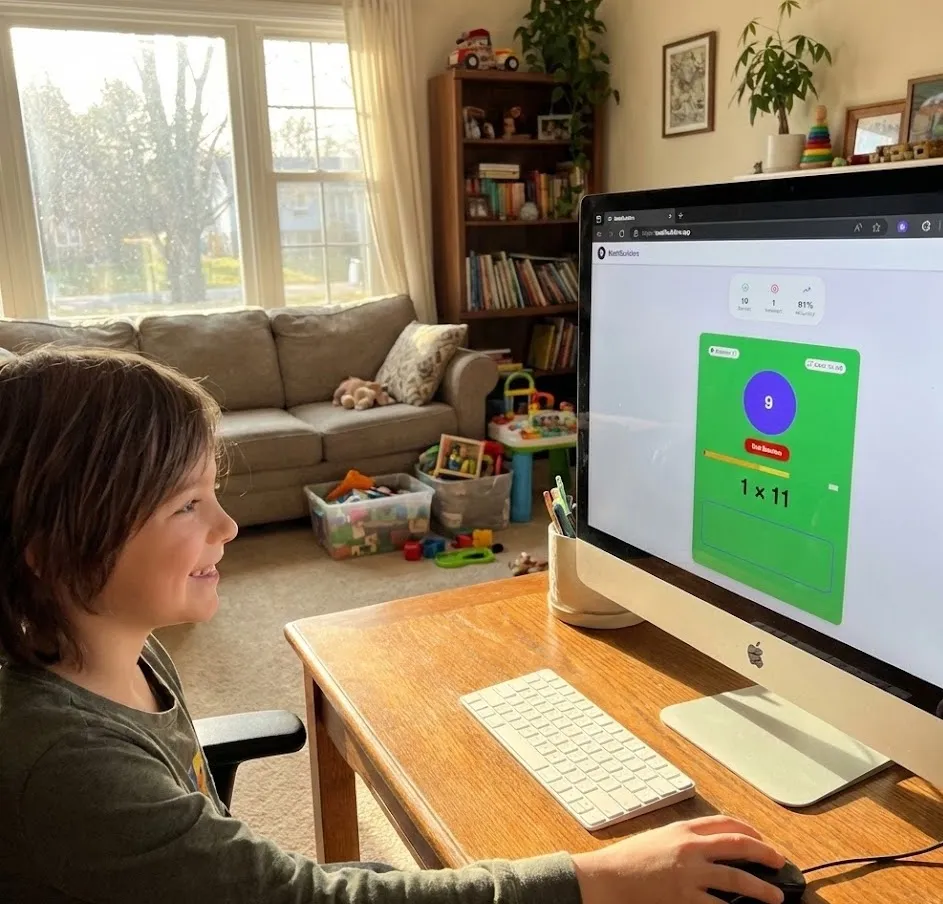
There is a visible countdown — structure helps most kids settle in. The difference is that a big End Session button sits right next to it the entire time. The kid is never trapped by the clock.
- Silent per-card speed grading
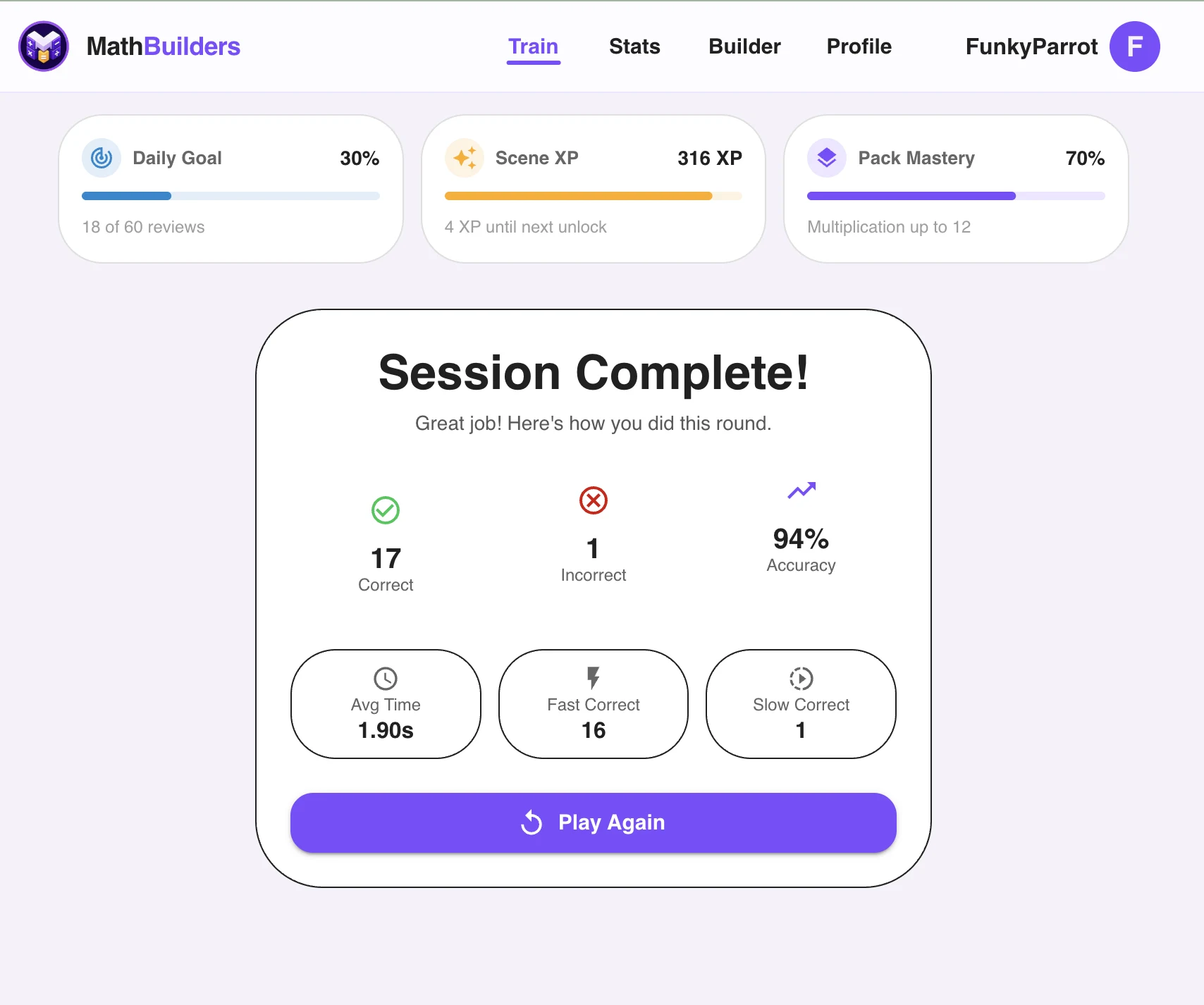
Per-card response time is measured in the background to drive the spaced repetition queue. The kid never sees their own time per card.
- Forgiving misses
A wrong answer just sends the fact back to today. No buzzer, no red flash, no public score.
- Private dashboard
Progress is visible to the parent or kid, but not to peers. No leaderboards, no class-wide compare.
- Short sessions
2 to 5 minutes is below the threshold where most kids start to dread practice — and they can opt out earlier any time they want to.
The Speed-Without-Pressure Trick
Math Builders measures response time on every card. It uses that number to push or hold the spacing interval — under 3 seconds and the fact graduates further out, over 3 seconds and it stays in rotation. But the kid never sees a per-card stopwatch. They see a card, type an answer, get the next card. The speed signal does its job silently inside the scheduler.
That is the difference between using speed as a tool (good) and using speed as a threat (bad). For the underlying mechanism see how to build math automaticity. For the end-session-anytime mechanic specifically see math facts without time pressure.
If Your Kid Already Has Math Anxiety
- Week 1
Tell the kid explicitly: tap End Session whenever you want, your progress is saved. Goal is showing up, not performance. Many anxious kids end at 2 to 3 minutes the first week — that is fine.
- Week 2
The session feels familiar. Most kids stop noticing the timer and run closer to the longer end of the 2-to-5-minute range voluntarily.
- Week 3+
The 2-to-5-minute container is just the rhythm now. Around week 4 most parents notice the kid voluntarily mentioning a math fact at the dinner table. That is the anxiety wall coming down.
What It Is Not
Stress-free is not low standards. Under-3-second recall is still the bar. The 30-day plan is still a 30-day plan. The kid still does the work. What changes is the framing: forced completion is removed, per-card timing happens silently, and the daily session length is short enough — and escapable enough — that the kid does not develop avoidance.
Try It
For the routine that pairs naturally with this approach, see 5-minute math practice. For the XtraMath comparison (the most-asked-about forced-session alternative) see XtraMath alternative, or for the disappearing-prompt complaint specifically, see the Reflex Math alternative. The session can end whenever the kid wants — progress saves automatically.
10-card sample. No account required.
Frequently Asked Questions
Stress-free math practice is daily fact work that does not depend on forced completion, public scoring, or high-stakes accuracy thresholds. The session has structure (a visible countdown, a queue of due facts) but the kid can end the session at any moment via a visible "End Session" button. The timer provides shape; the exit removes the trap.
For some kids, yes — but the trigger is usually being trapped by the clock, not seeing one. About 30-40% of elementary kids develop measurable math anxiety in response to forced timed drills, especially when scores are visible or compared. The anxiety itself reduces working memory capacity, making the kid worse at the math they actually know. Removing the trap (forced completion, public comparison) lifts the ceiling without abandoning structure.
Yes — recall speed is part of the definition of fluency. The trick is to measure it without weaponizing it. Math Builders records the per-card response time silently and uses it to drive the spaced repetition queue. The kid sees a card and a card-flip animation, not a stopwatch on every problem.
Yes. The under-3-second bar is still applied; it just runs in the scheduler instead of being shown to the kid as a per-card timer. The fluency result is the same as a hard-timed drill, without the working-memory tax that anxiety introduces.
Stress-free practice is especially effective for them. The 2-to-5-minute sessions are short, the End Session button removes the "I have to finish or fail" pressure, and the lack of public scoring rebuilds confidence quickly. Most kids with mild anxiety relax into the routine within 1 to 2 weeks.