
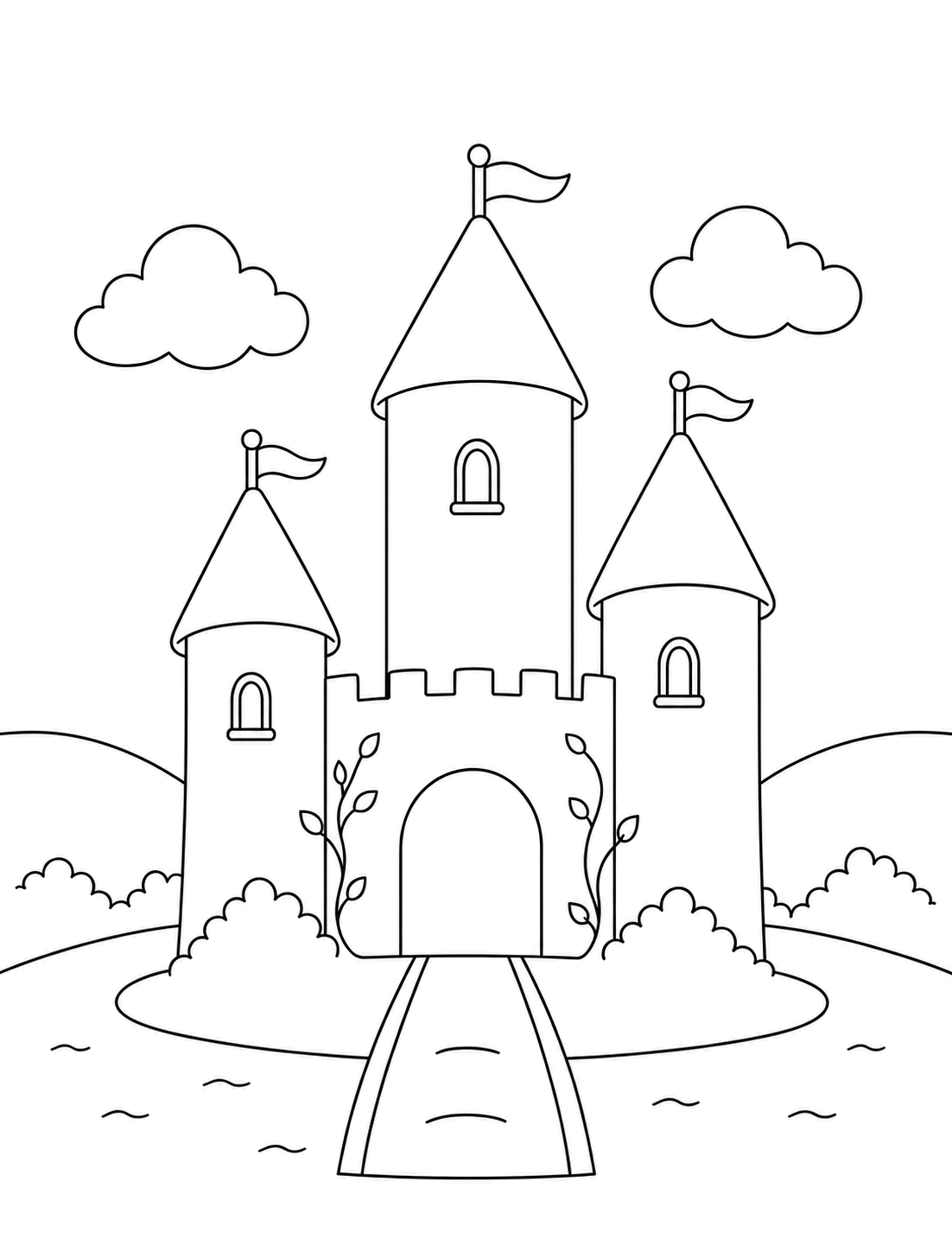
Print a division color by number sheet
Pick a picture
Picture collection
Two pages: the worksheet, then the answer key.
Teaching a class? Give every student short daily practice, free
A printed sheet is one round of practice. A free Math Builders class adds short daily fact practice beside it, and it supplements your math curriculum rather than replacing it.
- One free class, with no student limit.
- Students tap their name at a class link. No student email addresses.
- Practice takes 2 to 5 minutes at a time, alongside your curriculum.
- Printable home cards for families, from the class workflow.
Which divisors fit which grade
Division facts are multiplication facts asked backwards, so the divisor to print follows the times table a class already knows.
Grade 3, with the matching table
Dividing by 2, 5 and 10 is the easiest place to start. Each quotient is a half, a fifth or a tenth that children already know from counting, so the sheet introduces division on solid ground.
Grade 3 into Grade 4
Dividing by 3 and 4 is where children have to start thinking of a division fact as a missing multiplication fact. Print it the week after the same times table sheet.
Grade 4
Dividing by 6, 7, 8 and 9 needs the slow multiplication facts to be secure first. A child who still counts up to 7 × 8 will also count up to 56 ÷ 7, and the sheet will show it.
Grade 4 and Grade 5
Dividing by 11 and 12 extends division past the standard 10 × 10 facts. Use it with fourth and fifth graders, or as an extension for a child who finished early.
How long a division sheet takes
Plan 20 to 25 minutes for a fourth grader on a new divisor and about 15 minutes on a divisor the class has practiced. Division is slower than multiplication for most children, and the larger dividends, like 132 ÷ 11, slow it down further.
Split the work if you need to: color only the regions whose quotients a child can name, then come back to the rest after a break.
Using the sheet as a division center or early-finisher task
Pair each division sheet with the multiplication sheet for the same number. A child colors the times table sheet first and the division sheet second. The two sheets use different facts, so compare accuracy and effort, not single regions: a child who colors the 6s cleanly and then stalls on dividing by 6 shows the gap between recalling a product and recalling it backwards.
For early finishers, ask for the fact family on the back of the sheet. For 42 ÷ 6 = 7, the child writes 6 × 7, 7 × 6 and 42 ÷ 7. The answer key checks the quotient; the family checks that they understood where it came from.
Division color sheets are a multiplication check in disguise
The facts on each sheet run from the divisor itself up to 12 times the divisor. Dividing by 6 starts at 6 ÷ 6 and ends at 72 ÷ 6. A divisibility check helps a child see whether a number belongs on the sheet at all, which is a different skill from recalling the quotient.
A slow division sheet usually points back to a multiplication gap, not a division one. If a child stalls on 63 ÷ 9, go back to the 9s sheet before printing another division one.
More color by number worksheets by operation
Frequently Asked Questions
The one that matches the times table your class finished last. Division by 6 is the sheet to use after the 6 times table, not before it.
No. Every fact is an exact whole-number quotient, from the divisor divided by itself up to 12 times the divisor.
No. These pages cover divisors 2 to 12, the same range as the fact-set pages. Dividing by 0 is undefined, and dividing by 1 gives back the same number, so neither needs a practice sheet.
Yes. It prints on a separate page after the worksheet. There is no signup.
Yes. The picture picker above the sheet offers 24 pictures, and the worksheet and answer key regenerate on whichever you choose.