Games You Can Play Now
This page grows as more division games are added. Each one gets its own page with a how-to-play section and worked examples of what to type, so a child can start without an adult reading instructions aloud.
Why Quotient Recall Matters
Division is the fact family most children solve by working backward instead of recalling forward. Ask a fluent child what 7 times 8 is and the answer comes in a beat; ask the same child what 56 divided by 7 is and many start hunting through the sevens table until a match turns up. That detour costs real time, and it shows up everywhere division does: long division, reducing fractions, unit rates, and any word problem that splits a total into equal groups. A learner who can only find a quotient by guessing multiples is doing more arithmetic than the problem in front of them requires.
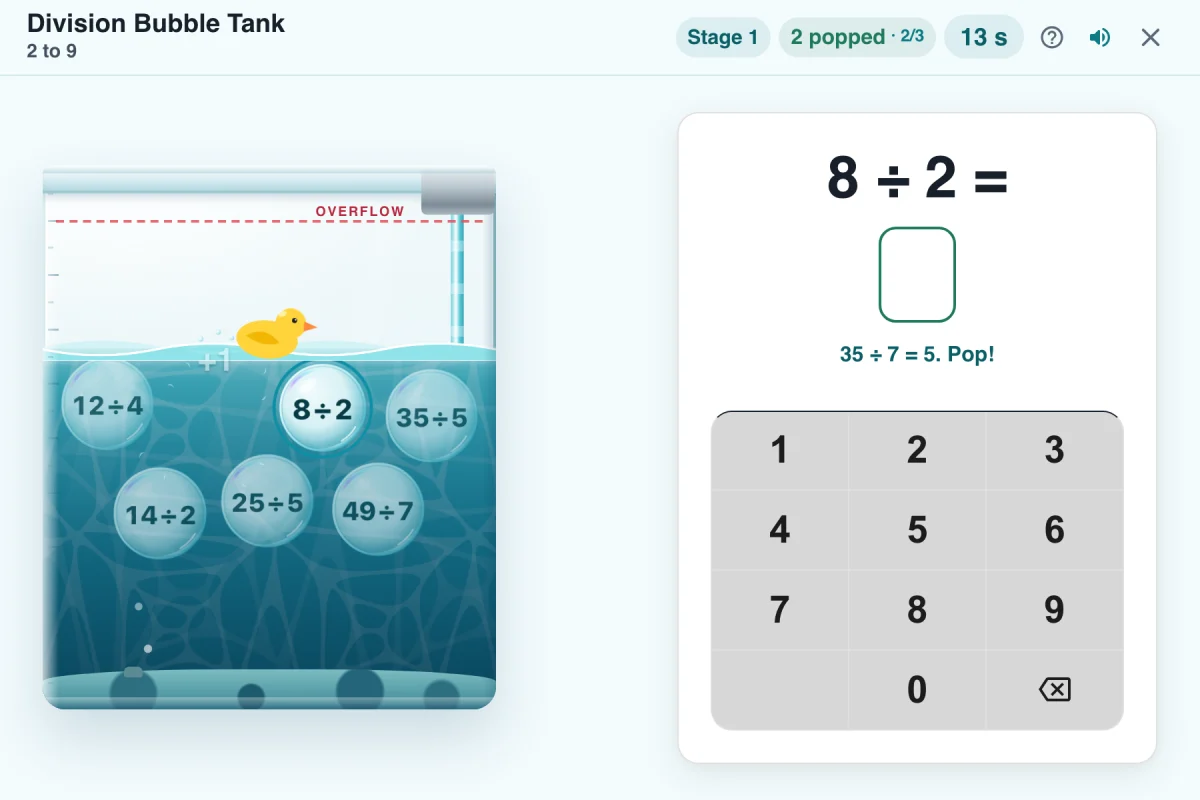
Division Bubble Tank asks for the quotient directly, with the rising water keeping the pressure honest. There is no scratch space and no multiplication table to scan; the fact has to come from memory before the water reaches the glass lid. A learner working the 2 to 9 facts gets a calmer tank and a smaller table; a class that already knows its multiplication tables can turn on the full 1 to 12 set, where the answers are those same tables read backward.
How the Glowing Bubble Keeps It Honest
Bubble Tank for multiplication lets a player pop whichever floating fact they know, because two different products almost never start with the same digit. Division breaks that trick: quotients only run from 2 to 12, so with seven bubbles afloat, several would often share a first digit, and a fast guess could pop the wrong one by accident. Division Bubble Tank answers that by making only one bubble answerable at a time. The oldest bubble still floating glows, and that is the fact to solve; pop it and the glow moves straight to whichever bubble has been waiting longest, so a learner works through the tank in order instead of skimming for the easy one.
The game does not judge a keystroke until it has as many digits as the glowing fact's own answer, so a single press of 1 is never marked wrong just because the true quotient starts differently. Get the full answer right and the bubble pops and the water drops a step; get it wrong and the water rises a little instead, an honest read on whether that one fact is solid rather than a lucky pop borrowed from a bubble on the other side of the tank.
Playing Division Bubble Tank Alongside Division Practice
Division Bubble Tank rewards a fact a learner already knows; it does not teach one that is missing. A child who leaves the same quotient glowing round after round until the tank floods is telling you exactly which fact needs work, and the game itself has no way to fix that, only to keep asking. Pair a few rounds with real practice and the picture gets useful fast: division facts practice drills the table with spaced repetition, division worksheets give a printable set for a quiet afternoon, and what division fact fluency means lays out why the recall speed matters in the first place.
Used that way, the game is the reason to practice and the proof that it worked: a best score is easy for a child to chase, and a rising one across a week is a better sign of progress than any single quiz.
Games for the Other Operations
- Multiplication games
3 games
- Addition games
2 games
- Subtraction games
2 games
Every game on Math Builders, for all four operations, is listed on the free math games page.
Frequently Asked Questions
Yes. Division Bubble Tank runs in the browser with no account, no download, and no in-app purchases. A Math Builders account is only for saving spaced-repetition practice progress; the game itself needs none.
Yes. Division Bubble Tank uses the same on-screen keypad Math Builders uses for practice, so it plays on a phone or tablet without opening the device keyboard. On a computer, the number row or numeric keypad works too.
Two fact sets, both with whole-number answers only. "2 to 9" divides by 2 through 9 with a quotient from 2 to 9, 64 facts in all. "1 to 12" divides by 1 through 12 with a quotient from 1 to 12, 144 facts, the multiplication table read backward.
No. The game shows which quotients a learner already has cold and which one keeps flooding the tank; it does not teach the missing ones. Short spaced practice that revisits slow facts is what builds the recall the game rewards, so use the game alongside that practice, not instead of it.
Not yet, and it would not work the way the addition and subtraction grids do. In a division grid, every cell along a row would equal that row’s own header, so a learner could read the answer straight off the header instead of recalling it. Division Bubble Tank is built around that limit instead of around it.
After a real round floods, post your bubble count under a nickname; a state or country is optional and never a real name, a town, or an email address. Each fact set keeps its own board of the top 100 counts of the day, the week, the month, and the year in US Eastern time. Practice rounds are never posted.