
What is a multiplication array?
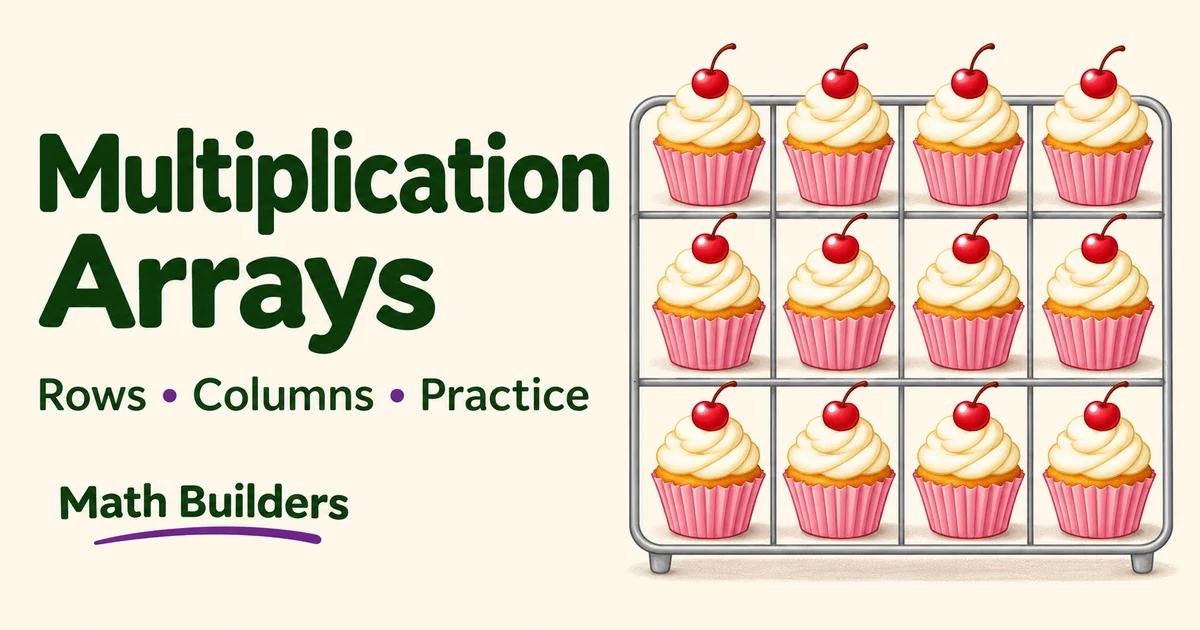
An array has the same number of objects in every row. The objects also line up in straight columns. These cupcakes make an array: 3 rows with 4 cupcakes in each row.
Cupcakes on a cooling rack
3 equal rows. The cupcakes also line up in columns.
Check the explanation and answers
There are 3 rows of 4 cupcakes: 4 + 4 + 4 = 12, so 3 × 4 = 12. Reading the 4 columns of 3 gives 4 × 3 = 12.
Three rows of 4 make 12 cupcakes: 3 × 4 = 12.
Which way do rows and columns go?
A row goes across, like a line of words. The rack has 3 rows.
A column goes up and down. The rack has 4 columns, with 3 cupcakes in each.
Try both build buttons above. The cupcakes stay the same. You are counting them in two different ways.
How do I write an equation for an array?
Multiply the number of rows by the number in each row. Four baking trays hold 7 cookies each. That is 4 × 7 = 28. The numbers 4 and 7 are the factors. The total, 28, is the product.
Four baking trays of cookies
4 equal rows. The cookies also line up in columns.
Check the explanation and answers
Four trays are 4 rows. Each row has 7 cookies. The total is 28: 4 × 7 = 28. There are also 7 columns of 4 cookies.
Why do 4 × 7 and 7 × 4 give the same total?
The cookie array has 4 rows of 7 and 7 columns of 4. You count the same 28 cookies either way: 4 × 7 = 28 and 7 × 4 = 28.
This page writes rows first. Follow your teacher’s order, and explain what each number counts.
Can you solve a new array?
A gardener plants seedlings in a tray. Enter your answers, then try adding one more row. What changes? What stays the same?
Seedlings in a garden tray
3 equal rows. The seedlings also line up in columns.
Check the explanation and answers
The first garden has 3 rows of 5 seedlings: 3 × 5 = 15. Add one row of 5 and there are 4 rows: 4 × 5 = 20. The number in each row stays 5.
Where can I get an arrays worksheet with answers?
Print six different questions: count, write equations, draw an array, find a mistake, and solve a story. Each PDF has a student page and a separate answer key.
Use the blank boxes in questions 4 and 6 for drawings. Keep each row equal and line up the columns.
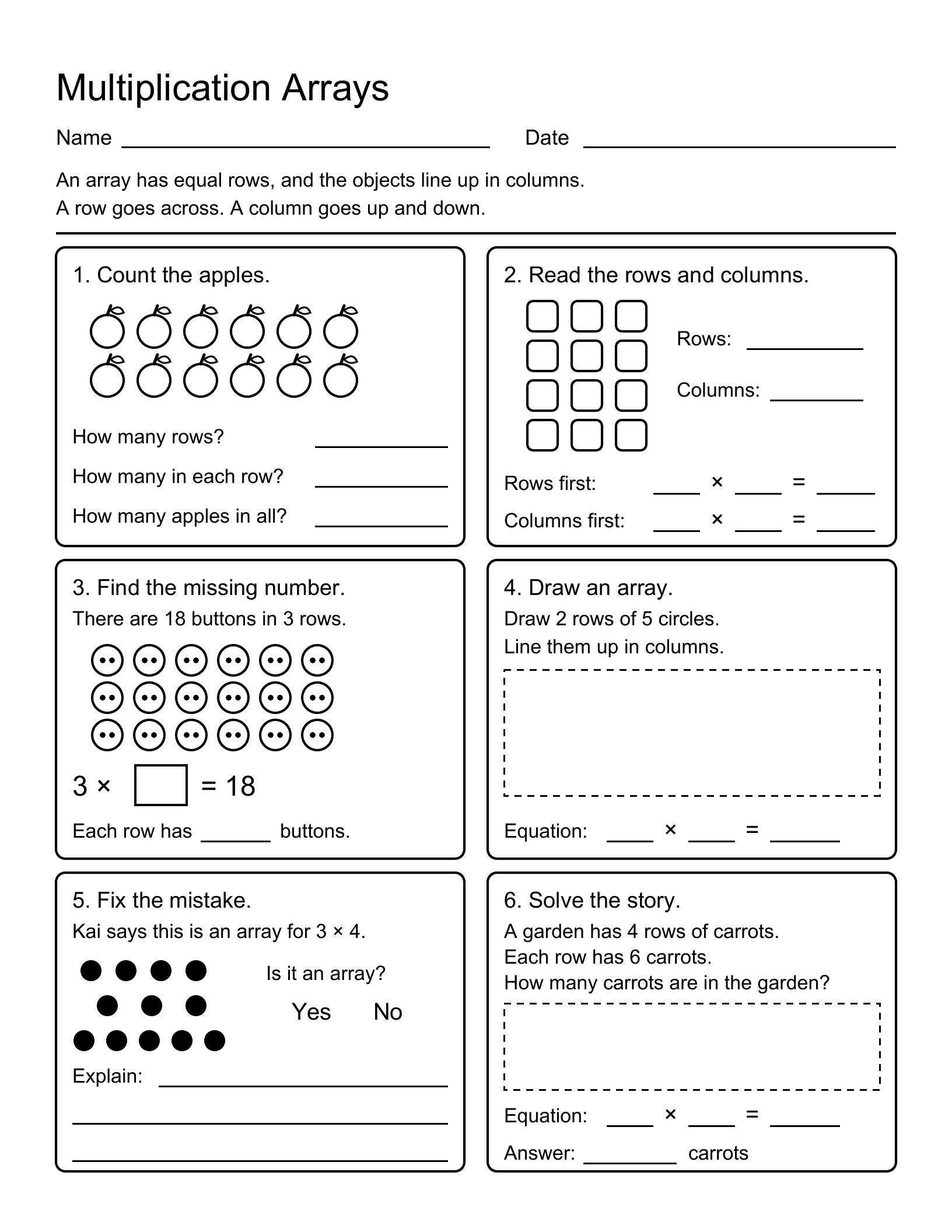
Download the worksheet and answer key (US Letter PDF)
Download the worksheet and answer key (A4 PDF)
Print at actual size. Try all six questions first, then check your work with the answer key.
More questions about arrays
Is an array the same as equal groups?
An array is one way to show equal groups. Three plates with 4 grapes piled on each are equal groups. To make an array, line up the grapes in 3 equal rows of 4, with straight columns.
Why do we multiply instead of adding rows and columns?
Four rows of 7 means four groups of 7 cookies. 4 + 7 = 11 only adds the number of rows to the number in one row. It does not count the cookies. Add 7 four times: 7 + 7 + 7 + 7 = 28. Or multiply: 4 × 7 = 28.
Can rows have different numbers of objects?
In a rectangular array, every row has the same number. Rows of 4, 3, and 5 dots have 12 dots altogether, but they do not make an array for 3 × 4. Try the mistake question on the worksheet.
How can I teach arrays with real objects?
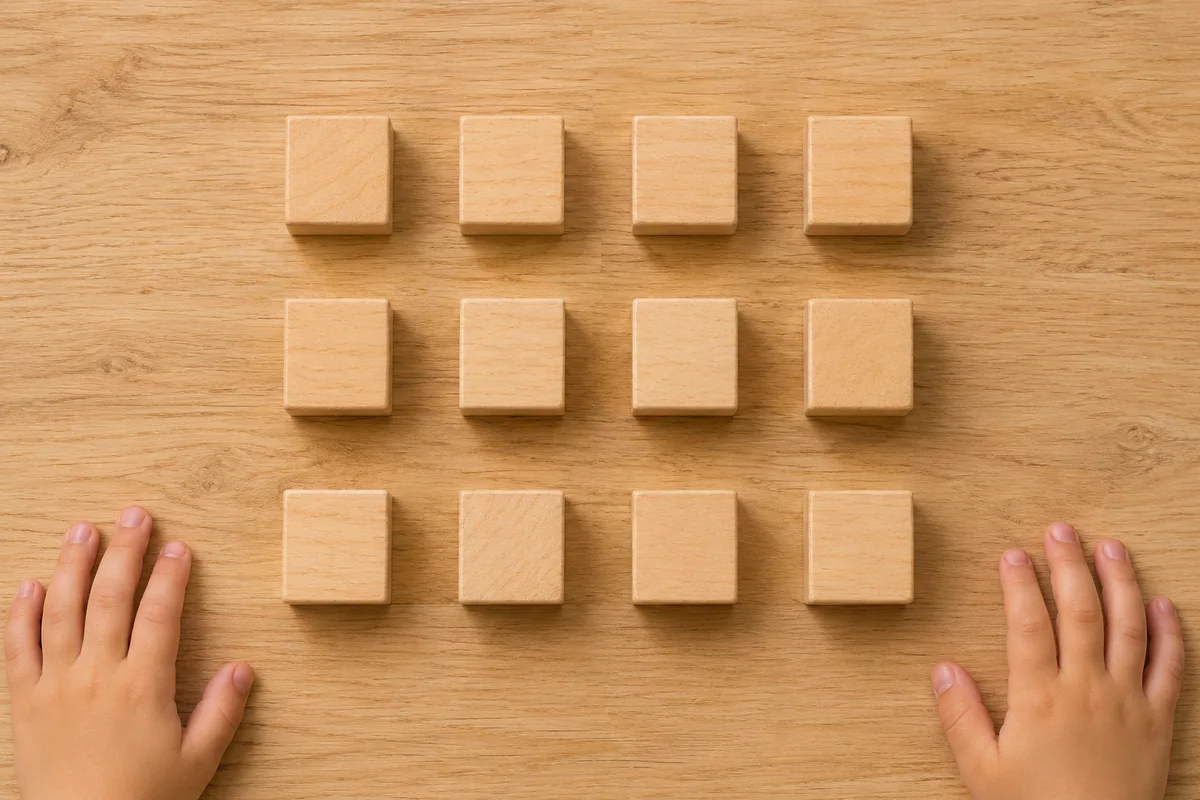
Use 12 cereal pieces or blocks. Ask your child to make 3 rows of 4. Touch one row, then one column. Ask what each number in the equation counts. Turn the arrangement and compare. Use hints when needed; then try a fresh example without help.
These activities are practice. Their answers stay on this page for checking. For a new challenge, ask your learner to draw 2 rows of 6 eggs and write an equation. The answer is 2 × 6 = 12.
For the next step, read multiplication and division fact families or plan short multiplication fact practice. Find more ways to teach multiplication at home.
Teaching connections: Common Core 3.OA.A.3 and 3.OA.B.5. This lesson supports work with arrays and operation properties.
Make a short multiplication practice plan
Use the Math Builders quiz to plan practice for your child or class.