
Days 1-3: Set the Baseline
Day 1: run a 40-fact mixed timed sheet. Time, accuracy, and the list of slow/wrong facts. This is the starting point you will compare against on day 30.
Days 2-3: explain the 3-second rule. The kid should hear it as a rule, not a guess — anything that takes longer is not yet memorized, no matter how confident the final answer feels. See how to build math automaticity for the full reasoning.
Days 4-10: Build the Queue
Daily 2-to-5-minute spaced sessions. Week 1 is heavy on the weak facts identified in the baseline test. The queue surfaces about 70 percent weak facts and 30 percent already-known facts to keep the kid's confidence intact.
By the end of day 10 the weak-fact list usually shrinks by 50 to 70 percent. Misses get reset to today and shown again before the session ends.
Days 11-20: Push Speed
The queue is now more diverse — most facts are due less often. This is where the 3-second rule earns its keep: any fact that comes back slow even when correct stays in rotation. Slow recall is silently rebuilding the spacing schedule for that fact, not graduating it.
Around day 15 most parents notice the kid answering during dinner-table mental math without prompting. That is the spacing curve flattening.
Days 21-29: Mixed-Table Interleaving
By week 4 the queue feels almost random. That is good. Interleaved practice (mixing facts across tables instead of doing the 6s then the 7s) is harder in the moment but produces dramatically stronger retention. Any fact that is still hiding inside a single-table context surfaces here.
Day 30: Retake the Timed Sheet
Same 40 mixed facts as day 1. Time. Score. Compare.
- Under 60 seconds, 95%+ accuracy
Automaticity reached. Switch to a 2-minute weekly maintenance session.
- 60-90 seconds, 95%+ accuracy
Fluent, not yet automatic. Run the same plan for 2 more weeks.
- Over 90 seconds or accuracy below 90%
Likely missed several days. Extend to 45 days and verify daily consistency.
What Makes 30 Days Possible
Three forces compound over the month:
- Spaced retrieval
Each successful recall pushes the next review further out, so daily session minutes stay constant while coverage widens. See the forgetting curve.
- The 3-second rule
Eliminates the "fluent-but-slow" trap that lets kids stay at 90-second timed sheets for years.
- Daily consistency
The brain consolidates memory during sleep. Daily sessions stack the spacing benefit; weekly sessions lose half of it.
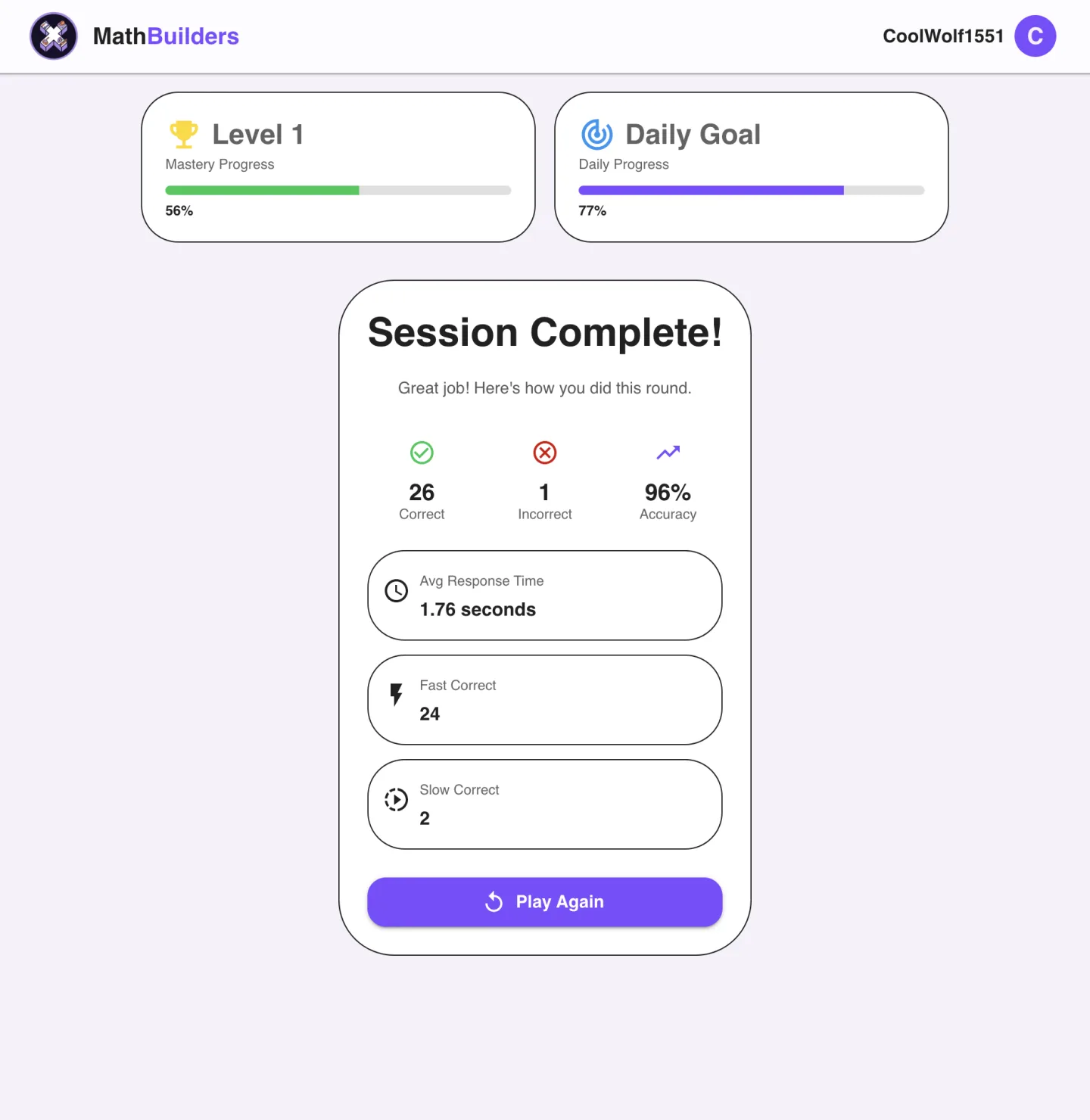
For the underlying decay model see the forgetting curve in elementary math. For the side-by-side against traditional worksheet drills see spaced repetition vs traditional math drills. To track progress day by day, print the multiplication facts mastery tracker PDF. To run the plan, start day 1 here — the queue, the 3-second rule, and the spacing are wired in.

Frequently Asked Questions
For most kids in 3rd or 4th grade with at least partial fluency on the easy tables (0, 1, 2, 5, 10), yes — 30 days of 2-to-5-minute daily spaced sessions is enough to reach automaticity on the full 0-12 grid. For kids starting from zero, plan for 6 to 8 weeks instead.
Five minutes is still a strong full-session target. Two minutes can maintain momentum on easy review days, while harder catch-up days usually need 3 to 5 minutes for the queue to turn over. More than 10 minutes usually hurts daily consistency because the kid pushes back. The 30-day plan assumes a 2-to-5-minute session every day, including weekends.
One missed day is fine. The plan has built-in slack — by week 2 the spacing is wide enough that a single day off does not cost much. Two or three missed days in a row is when the curve starts to bite; double up the session length the following day to catch the most-overdue facts.
Yes, and often faster than for younger kids. A 5th or 6th grader has more working memory and motivation, and the spaced repetition queue does not care about age. Expect 3 to 4 weeks for a motivated middle-schooler with the same daily routine.
A 40-fact timed mixed sheet at the end of day 30. Under 60 seconds with 95%+ accuracy is the automaticity bar. If the kid finishes in 60-90 seconds with high accuracy, they are fluent but not yet automatic — give it another 2 weeks. Below 60 seconds is the win condition.