
Learn with cookies
Imagine sharing 28 cookies equally among four baking trays. Give each tray one cookie. Keep going until all 28 cookies are on the trays. How many cookies does each tray have?
Each tray has seven cookies. Four trays with seven cookies each make 28 cookies: 4 × 7 = 28. Sharing 28 cookies equally among four trays gives seven cookies on each tray: 28 ÷ 4 = 7.
Share 28 cookies on 4 baking trays
Give each tray one cookie at a time.
Sharing complete. Four trays have seven cookies each.
Read the fact-family triangle
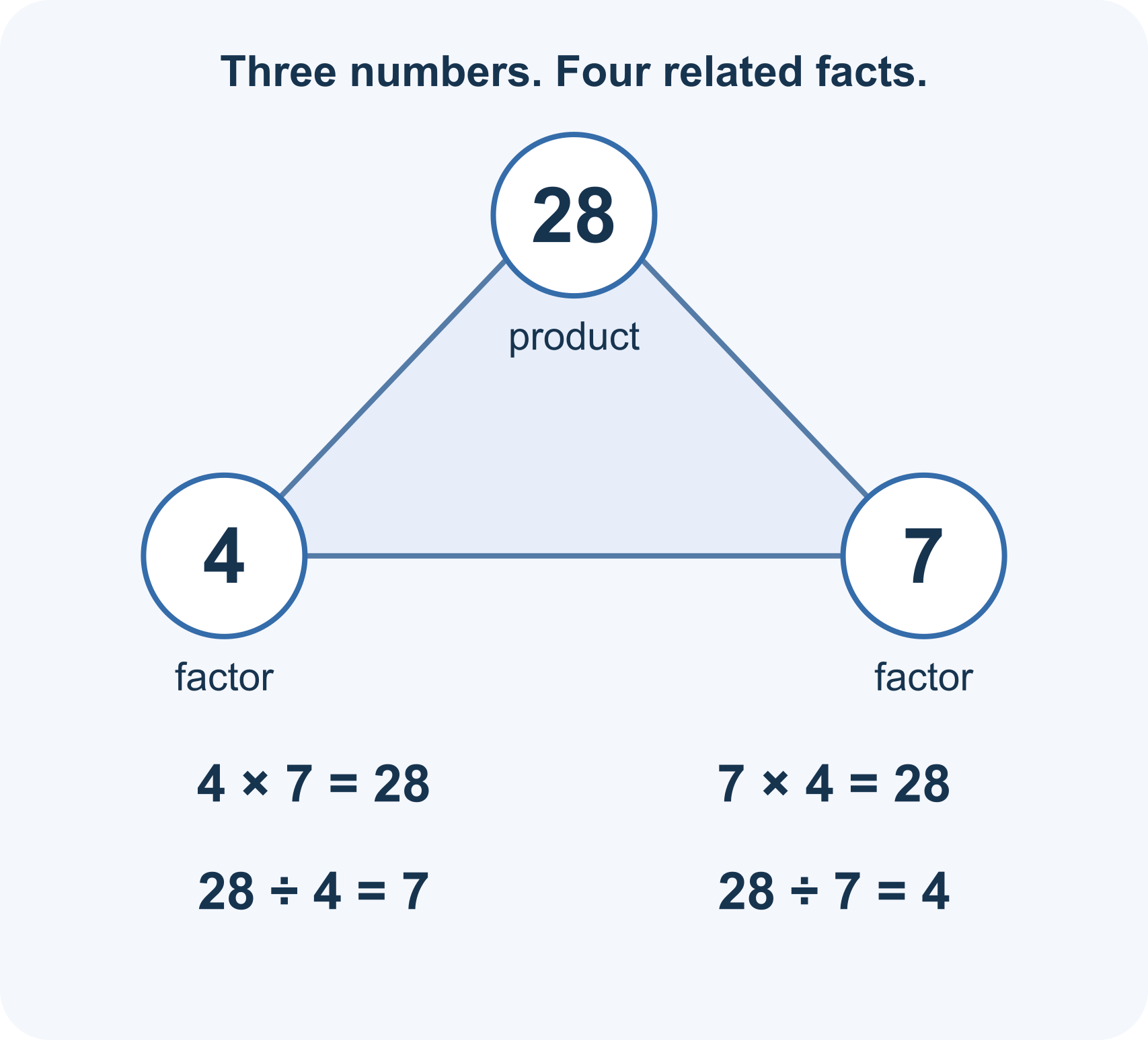
The triangle helps you keep track of the same three numbers. Put 28 at the top. Put 4 and 7 at the bottom.
The numbers you multiply are called factors. Here, the factors are 4 and 7. The answer to a multiplication fact is called the product. Here, the product is 28.
Write the four related facts
Use 4, 7, and 28 in each fact. Follow these four steps.
Multiply: four trays with seven cookies each make 28 cookies. Write 4 × 7 = 28.
Swap the factors: 7 × 4 also makes 28. Write 7 × 4 = 28. The total stays the same.
Share the total: share 28 cookies equally among four trays. Each tray gets seven. Write 28 ÷ 4 = 7.
Find the number of trays: put seven cookies on each tray. You need four trays for 28 cookies. Write 28 ÷ 7 = 4.
Try one together
Four trays hold seven cookies each. Use 4, 7, and 28 to fill in the missing numbers. Try each line, then check the answers below.
4 × 7 = □
7 × 4 = □
28 ÷ 4 = □
28 ÷ 7 = □
Answers
4 × 7 = 28
7 × 4 = 28
28 ÷ 4 = 7
28 ÷ 7 = 4
What if the two factors are the same?
Picture a chocolate bar with five rows of five pieces. It has 25 pieces: 5 × 5 = 25. Sharing 25 pieces equally among five people gives five pieces each: 25 ÷ 5 = 5.
Swapping 5 and 5 gives the same multiplication fact. There are only two different facts in this family: 5 × 5 = 25 and 25 ÷ 5 = 5. Write each one once.
Try it on your own
Use each set of numbers to write two multiplication facts and two division facts. If the two factors are the same, write just one of each. Then draw a picture to explain one fact. Check your work with the answers below.
3, 8, and 24
5, 9, and 45
6, 6, and 36
Complete 7 × □ = 56, then write the matching division equation.
Answers
3 × 8 = 24; 8 × 3 = 24; 24 ÷ 3 = 8; 24 ÷ 8 = 3.
5 × 9 = 45; 9 × 5 = 45; 45 ÷ 5 = 9; 45 ÷ 9 = 5.
6 × 6 = 36; 36 ÷ 6 = 6. These are the two different facts.
7 × 8 = 56; 56 ÷ 7 = 8.
Print a fact-family worksheet
Choose a times table, then its products
Choose a times table and tap the products your students need. Your selected families stay when you switch tables. Each family prints once.
Choose products in the 3 times table
Selected families (0)
No families selected yet.
For example, choose the 3 times table, then 18 and 24. This adds families 3, 6, 18 and 3, 8, 24. Switching tables keeps your choices. Reversed factors are the same family.
Choose at least one product in a times table to preview or print.
Turn the next step into a practice plan
Use the Math Builders quiz to plan short fact-practice sessions for your child or class. Teach the relationship first, then use practice to build recall.
For parents and teachers
Start with objects or the cookie animation. Ask the learner what 4, 7, and 28 mean in the picture. Then connect the picture to the triangle and the four facts.
If a learner is stuck on 4 × □ = 28, ask: “How many cookies go on each of the four trays?” Use 28 ÷ 4 = 7 to check. If a division fact starts with 4 or 7, point back to the total of 28.
Keep zero out of this worksheet routine. Division by zero is undefined, so a family that includes zero does not follow the same four-fact pattern. The generator uses factors from 1 to 12.
At home, use small objects as pretend cookies. In class, draw four trays with seven cookies each. Ask the learner to explain one fact before writing all four.
Once the learner can explain a family, practise it in short sessions. Mix familiar facts with one family that needs more practice. Use the worksheet picker to choose those families.
Teaching references
These references describe the related arithmetic standards and teaching strategies.
Common Core 3.OA.B.6 and 3.OA.C.7: multiplication and division relationships