
Fluency Is Not the Same as Memorization
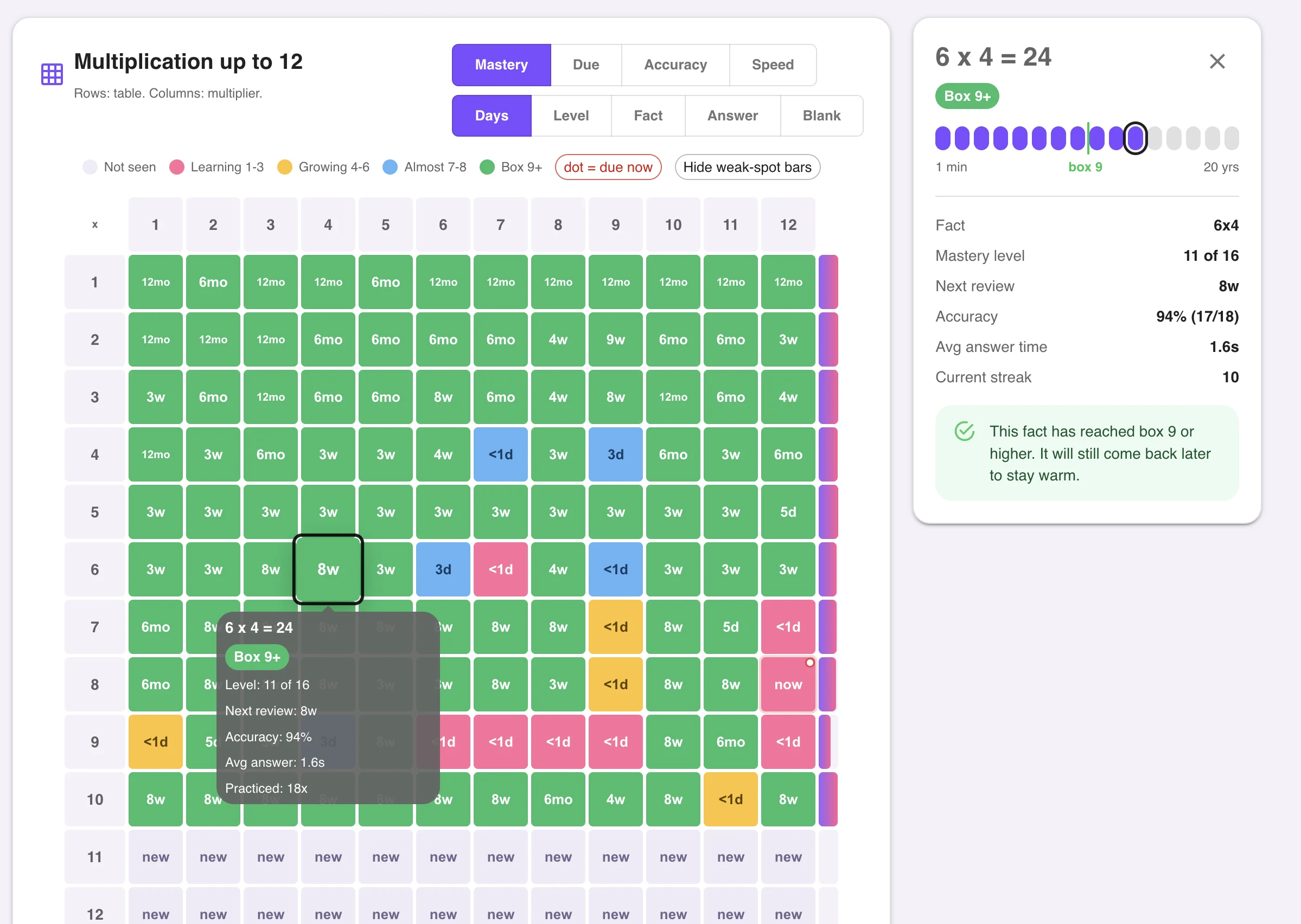
Memorization is holding a fact in short-term memory. Fluency is automatic recall from long-term memory while doing other work. A child can pass a Friday quiz on the 7s and still freeze on 7 × 6 two weeks later inside a fractions problem. That is the gap fluency closes.
The research is clear. The National Council of Teachers of Mathematics and decades of cognitive science point to the same answer: fluency is built by short, frequent retrieval, not by long worksheets.
The 3-Second Rule
Three seconds is the practical cutoff between recall and reconstruction. If your child answers in under three seconds, the fact is in long-term memory. Slower than that, they are reconstructing it (skip-counting, doubling, breaking apart). That is fine while learning, but it costs working memory in any multi-step problem.
Use the 3-second cutoff as a daily diagnostic. It tells you in 30 seconds which facts to focus on and which to leave alone.
The 2-to-5-Minute-a-Day Method
Three rules. That is the entire system.
- Short sessions
2 to 5 minutes per day. No exceptions for consistency, no extensions for ambition.
- 3-second target
Anything answered in under 3 seconds counts. Anything slower goes back into the queue.
- Spaced reintroduction
Missed facts come back at widening intervals so the brain has to retrieve them from memory, not from the page.
Want the deeper method? See the exact spaced repetition schedule for math facts walks through the exact intervals.
Fluency by Operation
Each operation has its own fluency arc. Most parents underestimate how much addition fluency carries over.
- Addition and subtraction fluency (K to 2)
The foundation. Doubles, near-doubles, making 10. Without these, multiplication recall stays slow.
- Multiplication fact fluency (3 to 5)
The high-leverage operation. Once mastered, division comes much faster.
- Division fact fluency (3 to 5)
Divisions are inverse multiplications. Strong multiplication recall makes division almost free.
Common Fluency Mistakes Parents Make
- Confusing accurate with fluent
A child who gets 9 out of 10 right in a short session is accurate, not fluent. Fluency requires speed too.
- Practicing what they already know
Drill is comfortable. Drill on the easy facts is wasted time. The slow facts are the entire point of practice.
- Long sessions, no spacing
Twenty minutes once a week underperforms 2 to 5 minutes a day. Retention follows frequency, not volume.
Build Fluency With MathBuilders
Still comparing tools? See the best apps for math facts, ranked across addition, subtraction, multiplication, and division.
MathBuilders was built around the 3-second cutoff and spaced reintroduction. Sessions are 2 to 5 minutes, kids can stop anytime without losing progress, and missed facts come back at widening intervals. No long forced sessions, no facts marked done that quietly disappear two weeks later.
Start with the math facts practice guide for the broad routine, or use the multiplication facts practice tool when the current goal is 0-12 multiplication fluency. You can also jump into Training mode to see the method in action.
Going deeper: see the automaticity-vs-fluency walkthrough for the under-3-second bar, or the 30-day multiplication plan if you want a fixed timeline. For the no-pressure version, the stress-free practice guide covers the math-anxiety angle.

Frequently Asked Questions
Math fact fluency is the ability to recall basic addition, subtraction, multiplication, and division facts accurately, quickly, and with little mental effort. A fluent student answers most single-digit facts in about three seconds or less.
Time them on a mixed set of 40 single-digit facts. If they finish in 60 to 90 seconds with at least 95 percent accuracy, they are fluent. If they pause to count or skip-count, they are still in the recall-building stage.
With 2 to 5 minutes of focused, adaptive practice per day, most students build fluency in a single operation in 6 to 12 weeks. Long worksheet sessions take far longer because most of the time is spent on facts the student already knows.
Timed tests measure fluency. They do not build it. The thing that builds fluency is short, daily, adaptive recall practice that targets the specific facts a student is slow on.