
Games You Can Play Now
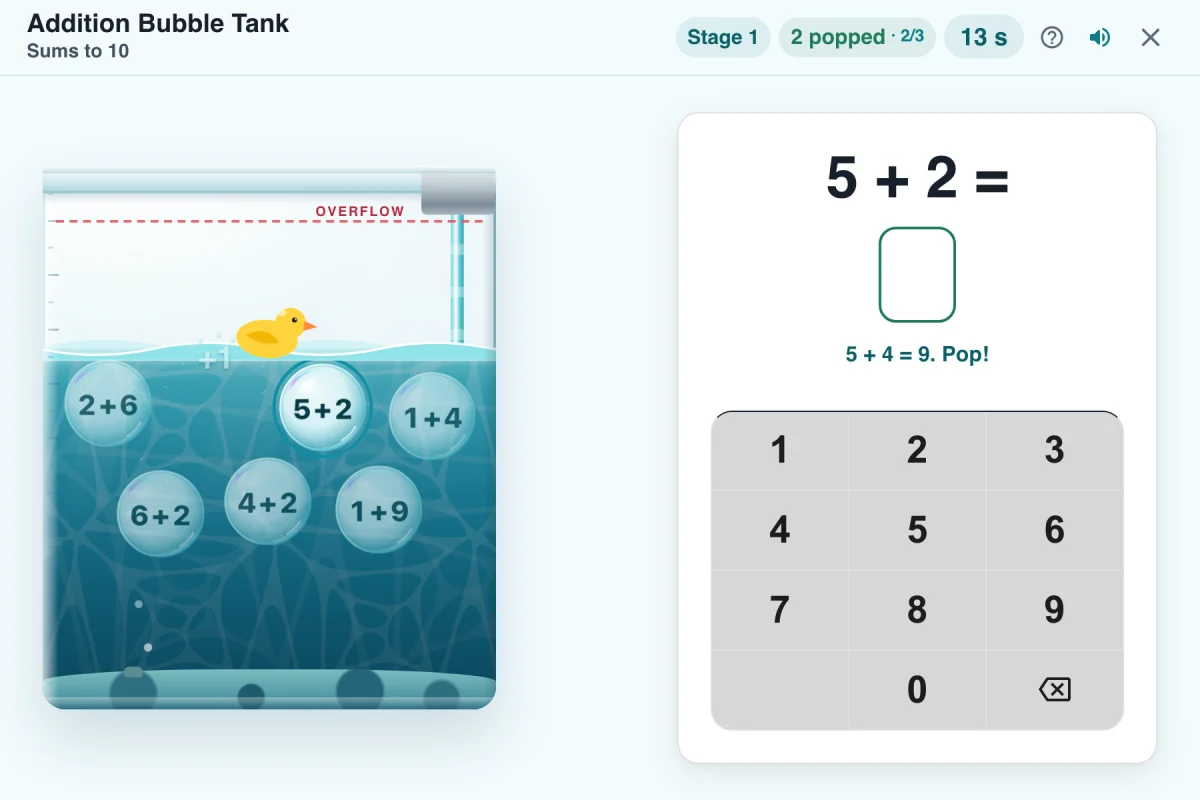
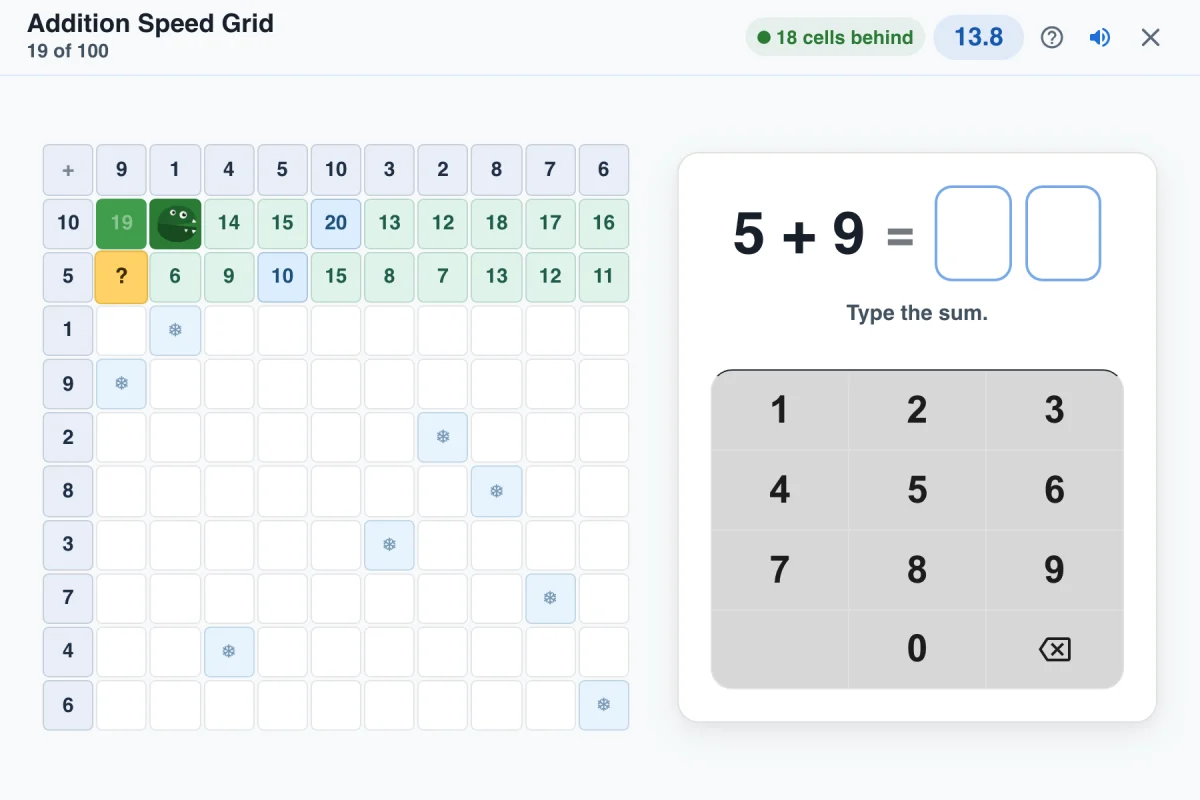
Two games so far, one for choosing a sum from a rising tank and one for filling a whole chart ahead of a chasing snake. More addition games land on this hub as they ship, each with its own how-to-play walkthrough and worked examples of what to type.
Sums to 10, Then Sums to 20
Bubble Tank splits into two ranges. Sums to 10 holds both addends between 1 and 9 so nothing ever adds past 10, which is the range a kindergartner or a beginning first grader is working inside. Sums to 20 widens each addend to 1 through 10, so totals climb as high as 20, which is where a first or second grader lands once regrouping and two-digit thinking start to matter. A learner who has the smaller range solid can move to the wider one without the game changing shape underneath them.
The Speed Grid has no range switch. Its board is the whole addition table: addends 1 through 10 on the 10 × 10 grid, so sums reach 20, or 1 through 12 on the 12 × 12 grid, so sums reach 24. Start it once sums to 20 feel quick in Bubble Tank.
Doubles get special billing in both games. A fact like 6 + 6, 7 + 7, or 9 + 9 is usually the first kind of sum a child commits to memory on its own, well before the rest of the table feels automatic. The Addition Speed Grid leans on that: every double on the board freezes the chasing snake for two seconds, so the strategy a child reaches for first is also the one that buys the most safety. Addition Bubble Tank keeps doubles in the mix too, just as one glowing sum among many rather than a special case.
Why Quick Recall of Sums Pays Off Later
A child who has to count on fingers for 8 + 5 is not just slow at addition; the same gap shows up the moment subtraction and place value enter the picture. Regrouping in subtraction depends on knowing, without working it out, that 13 take away 8 is the flip side of 8 + 5, and carrying in multi-digit addition depends on recognizing a ten inside a sum on sight. Recall that has to be rebuilt every time is recall that runs out of time on a harder problem.
That is the case for treating fast sums as a real goal rather than a nicety. A game with a clock or a rising tank gives that goal a reason to matter today, in a round that ends in under a minute, instead of a promise about a test next month.
Games Alongside Practice and Worksheets
These games are a reward for recall that already exists, not a method for building it. For steady, repeatable review, printable addition worksheets cover the same sums to 10 and sums to 20 ranges a page at a time. For the longer explanation of what fluency means at this age and how spaced practice gets a learner there, read addition and subtraction fluency. The games here work alongside that kind of practice; they are not a substitute for it.
Games for the Other Operations
- Multiplication games
3 games
- Subtraction games
2 games
- Division games
1 game
Every game on Math Builders, for all four operations, is listed on the free math games page.
Frequently Asked Questions
Yes. Every game on this hub runs in the browser with no account, no download, and nothing to buy. Signing in only saves practice progress inside Math Builders; the games themselves never ask for it.
Yes. Each one uses the same on-screen keypad Math Builders uses for practice, so a touch device never has to open its own keyboard. On a computer, the number row or the numeric keypad works too.
Bubble Tank has two ranges, chosen on the game card before you press Play. Sums to 10 keeps both addends between 1 and 9 so the total never passes 10, which fits a kindergartner or a first grader just starting out. Sums to 20 uses addends from 1 to 10, so totals run all the way to 20, for a first or second grader adding two-digit-friendly numbers. Speed Grid has no range switch: its board is the whole table, with addends 1 to 10 on the 10 × 10 grid (sums up to 20) or 1 to 12 on the 12 × 12 grid (sums up to 24).
A double is a fact like 6 + 6 or 8 + 8, where both addends match. It is usually the first kind of sum a child memorizes outright, and the Addition Speed Grid rewards that head start directly: landing on a double freezes the chasing snake for two seconds.
No. A game shows what a child can recall under a little pressure; it does not, by itself, teach the sums that are still shaky. Use the games as the payoff and short daily practice as the way there.
Bubble Tank on sums to 10 suits kindergarten through first grade. Sums to 20 and the Speed Grid suit first and second grade, which is roughly when most curricula introduce two-digit addition and regrouping.