
Build Your Worksheet
1. Pick one to four fact families
2. Choose a style
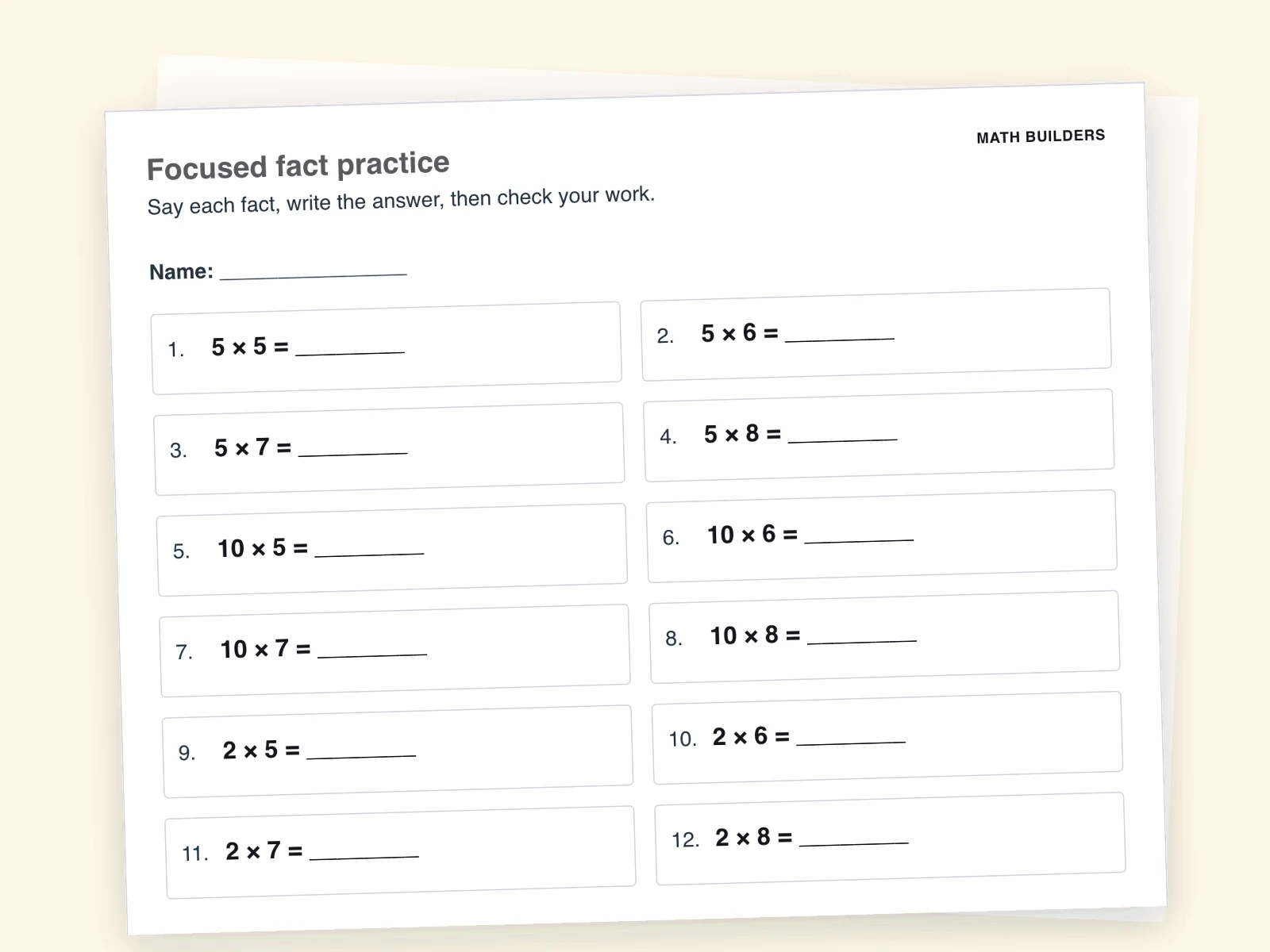
Focused fact practice
Say each fact, write the answer, then check your work.
Name: ________________
1.
5 × 5 = ________
2.
5 × 6 = ________
3.
5 × 7 = ________
4.
5 × 8 = ________
5.
10 × 5 = ________
6.
10 × 6 = ________
7.
10 × 7 = ________
8.
10 × 8 = ________
9.
2 × 5 = ________
10.
2 × 6 = ________
11.
2 × 7 = ________
12.
2 × 8 = ________
Answer key
Check after the worksheet is complete.
Name: ________________
1.
5 × 5 = 25
2.
5 × 6 = 30
3.
5 × 7 = 35
4.
5 × 8 = 40
5.
10 × 5 = 50
6.
10 × 6 = 60
7.
10 × 7 = 70
8.
10 × 8 = 80
9.
2 × 5 = 10
10.
2 × 6 = 12
11.
2 × 7 = 14
12.
2 × 8 = 16
Worksheets for a Single Times Table
Working on one table at a time? Each times-table page has its own printable worksheet plus an online quiz for that table:
How to Use a Multiplication Worksheet Well
- Keep it short. One focused sheet per sitting — a tired child guessing through problem 30 is practicing errors.
- Time nothing on paper. Circle any fact that took more than about 3 seconds; those are the facts that need practice, even when the answer was right.
- Move the circled facts into retrieval practice. A worksheet shows you which facts are slow; 2 to 5 minutes of spaced repetition is what actually speeds them up.
- Reprint a fresh version tomorrow. The generator reshuffles problems each time, so answers cannot be memorized by position.
More Free Multiplication Tools
Multiplication table generator — a printable reference table from 0 to 20.
Multiplication facts mastery tracker — a printable grid for marking which facts are fast, slow, or missing.
Multiplication flash cards — online 0-12 cards plus a double-sided printable deck.
Times tables practice hub — quiz any table from 2 to 12 online.
Frequently Asked Questions
Right here. Pick your fact families above, then press print. You can save the sheet as a PDF from the same box. There is no account and no email gate.
Yes. Pick the fact families, preview the worksheet, and print or save it as a PDF. No signup, no email gate, and no watermark over the problems.
Multiplication facts are usually taught in 3rd grade and reviewed in 4th and 5th. Pick easier families (2s, 5s, 10s) for a beginner and the 6s-9s for a child closing out fluency.
One focused worksheet, twelve problems, is plenty on paper. Pair it with a few minutes of practice that brings back the facts they keep missing.
Not usually. A fixed worksheet spends most of its problems on facts the child already knows. Use it to check written work, and use short daily practice to move slow facts into fast recall.
Yes. Print as many copies as you need. Press "New version" between prints if you want each student to get a different set of problems.