
The Short Answer
The two programs answer different questions. MathFactLab answers "does my child understand how to get this fact?" — with visual models, fact families, and an untimed, leveled progression. Math Builders answers "does the answer arrive in under 3 seconds, and will it still be there next month?" — with spaced repetition, per-fact speed measurement, and 2-to-5-minute daily sessions.
Pick MathFactLab when a child is still learning what the facts mean. Pick Math Builders when the child can find the answer but slowly — counting up, skip-counting, or working the strategy every time. Use both when school covers the strategy side and home covers the daily recall habit.
What MathFactLab Does Well
- Strategy-first teaching
Facts are built through multiple visual models — number lines, ten frames, area models — so students construct number sense rather than blindly memorizing.
- Placement and leveled progression
A pre-assessment places each student, and levels advance at the student's own pace with teacher-adjustable accommodations.
- A calm, untimed environment
No countdown pressure while a child is still constructing understanding — the right call at that stage.
- Teacher dashboards and fact families
Addition/subtraction and multiplication/division are taught as connected families, with classroom reporting built in.
None of that is faint praise. For the learning stage of math facts, strategy instruction is what the research supports — our own math fact fluency guide says the same thing.
Where Math Builders Picks Up
Understanding a fact is not the same as owning it. A child who can derive 7×8 through a strategy still burns working memory doing it — and in long division or fractions, that cost shows up as errors and fatigue. Automaticity is the second stage: the answer arrives in under 3 seconds, no strategy needed, and it stays that way.
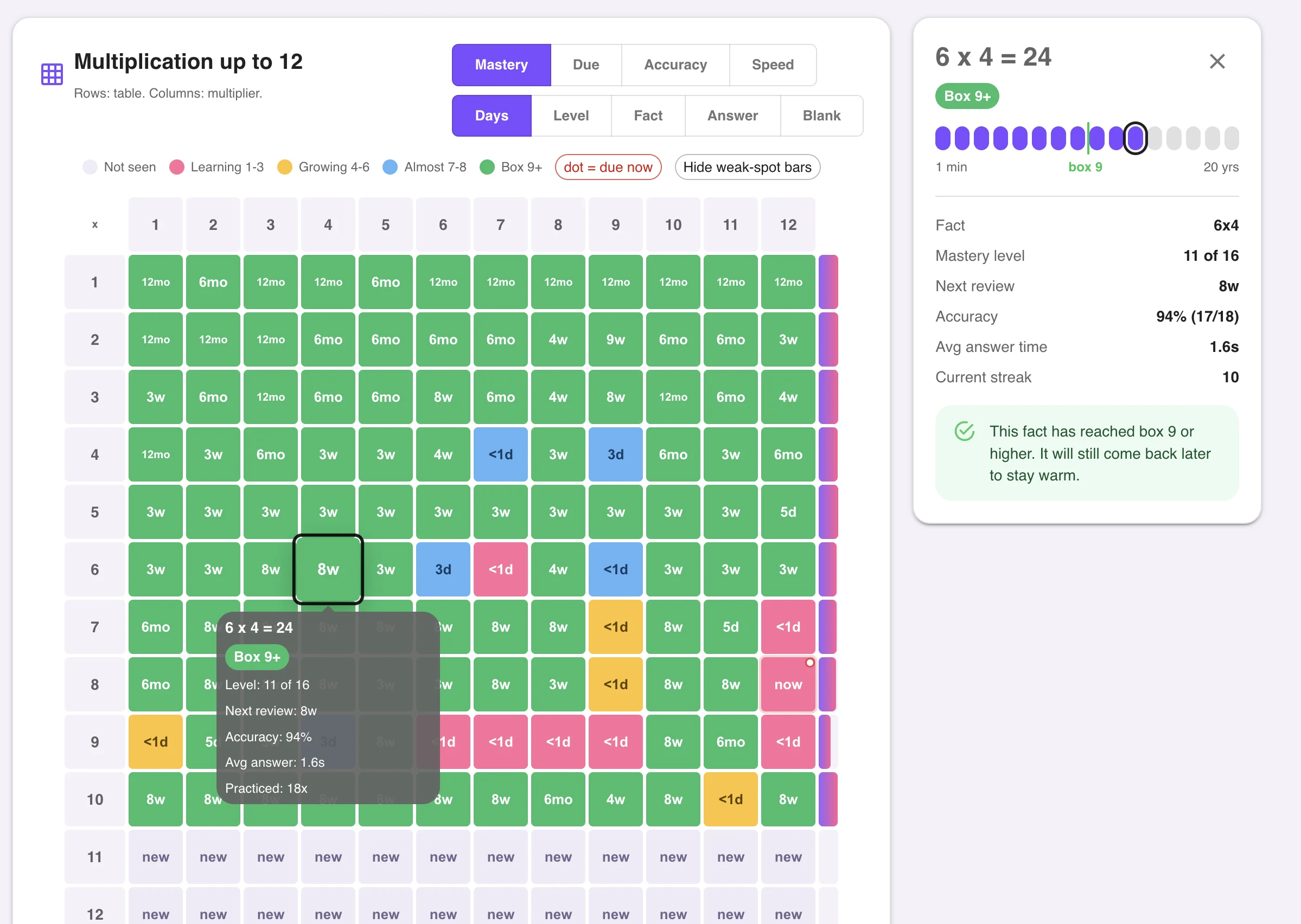
That stage is Math Builders' entire job. Every answer is timed per fact; anything slow or missed comes back on a spaced repetition schedule (today, tomorrow, 3 days, 7, 14, 30) until it is fast everywhere — across addition, subtraction, division, and multiplication up to 24×24. Sessions are 2 to 5 minutes with a clean stop, because the habit that survives a school-night is the one that builds fluency.

Side-by-Side
| Dimension | MathFactLab | Math Builders |
|---|---|---|
| Teaching approach | Strategy instruction: number lines, ten frames, area models, and other visual models build understanding of each fact. | Retrieval practice: spaced repetition with a 3-second recall cutoff makes facts the child already understands automatic. |
| Timing philosophy | Deliberately untimed — students get time to think a fact through. | Response speed is measured per fact, because fluency means fast and accurate. Sessions stay short so speed never becomes stress. |
| Operations | Addition/subtraction and multiplication/division, taught as fact families. | Addition, subtraction, division, and multiplication up to 24×24. |
| Placement | Pre-assessment places each student in a leveled progression. | The spaced repetition engine finds slow and missed facts continuously — placement is implicit and re-checked every session. |
| Session shape | Classroom-friendly practice blocks, teacher-configurable accommodations. | 2-to-5-minute daily sessions with a clean stop — built for the home routine that survives a school night. |
| Setup | Built around teacher accounts and class rosters; families use a family plan. | Works instantly for a family — try a session without an account. Teachers can add classes when they want them. |
| Pricing model | Free teacher pilot; school and district pricing is quoted; family plan available. Check their site for current terms. | Free to start and practice; premium unlocks family/class features. No app store, no install — it runs in the browser. |
Teaching approach
MathFactLab: Strategy instruction: number lines, ten frames, area models, and other visual models build understanding of each fact.
Math Builders: Retrieval practice: spaced repetition with a 3-second recall cutoff makes facts the child already understands automatic.
Timing philosophy
MathFactLab: Deliberately untimed — students get time to think a fact through.
Math Builders: Response speed is measured per fact, because fluency means fast and accurate. Sessions stay short so speed never becomes stress.
Operations
MathFactLab: Addition/subtraction and multiplication/division, taught as fact families.
Math Builders: Addition, subtraction, division, and multiplication up to 24×24.
Placement
MathFactLab: Pre-assessment places each student in a leveled progression.
Math Builders: The spaced repetition engine finds slow and missed facts continuously — placement is implicit and re-checked every session.
Session shape
MathFactLab: Classroom-friendly practice blocks, teacher-configurable accommodations.
Math Builders: 2-to-5-minute daily sessions with a clean stop — built for the home routine that survives a school night.
Setup
MathFactLab: Built around teacher accounts and class rosters; families use a family plan.
Math Builders: Works instantly for a family — try a session without an account. Teachers can add classes when they want them.
Pricing model
MathFactLab: Free teacher pilot; school and district pricing is quoted; family plan available. Check their site for current terms.
Math Builders: Free to start and practice; premium unlocks family/class features. No app store, no install — it runs in the browser.
MathFactLab details reflect mathfactlab.com as of August 2026 — always check their site for current features and pricing.
Use Both: Strategy First, Then Speed
If your child's school already runs MathFactLab, do not fight it — complete it. The clean division of labor: school time builds the strategies; 2 to 5 minutes at home each evening turns the same facts into instant recall. The child feels the difference within a couple of weeks, because homework stops stalling on arithmetic.
The reverse order also works: if recall practice in Math Builders shows a fact family that stays consistently slow and wrong, that is a signal the underlying strategy was never solid — a good moment for the visual-model treatment, at school or with our parent playbook for memorizing tables.
When MathFactLab Is the Right Call
- Your child is still learning what multiplication or subtraction means — strategy instruction comes first, full stop.
- A teacher runs it classroom-wide and the leveled progression is visibly working.
- Timed anything currently produces tears — build confidence untimed, add recall practice later.
Comparing more options? See our full ranked list of the best math fact apps for 2026 and the multiplication-specific best multiplication apps comparison.
Try the Recall Side
The fastest way to know whether your child needs the recall stage: run one free 2-to-5-minute session. If the per-fact results show right-but-slow answers, strategy knowledge is in place and automaticity practice is the missing piece. No signup, no install — it runs in the browser and works alongside whatever your school uses.
Frequently Asked Questions
MathFactLab is a strategy-based math fact fluency program for grades K-5. Students learn facts through visual models (number lines, ten frames, area models and more), get placed by a pre-assessment, and move through individualized levels. It is deliberately untimed and popular with teachers.
MathFactLab offers a free pilot for teachers, quoted pricing for schools and districts, and a family plan for home use. Check mathfactlab.com for current terms. Math Builders is free to start practicing, with premium family and class features.
They target different stages of fluency. MathFactLab teaches facts through strategies and understanding, without timing. Math Builders makes understood facts automatic: spaced repetition, a 3-second recall target, and 2-to-5-minute daily sessions. Many families use strategy instruction first, then recall practice — or run both side by side.
Automaticity is the specific goal Math Builders is built around: it measures per-fact response time and re-schedules slow facts at widening intervals until recall is fast everywhere. A strategy program tells you a child can work a fact out; recall practice makes the answer arrive in under 3 seconds.
Yes, and the combination is coherent: strategy instruction at school builds understanding, and a 2-to-5-minute recall session at home locks the same facts into fast memory. Neither replaces a math curriculum — both are fluency supplements.