
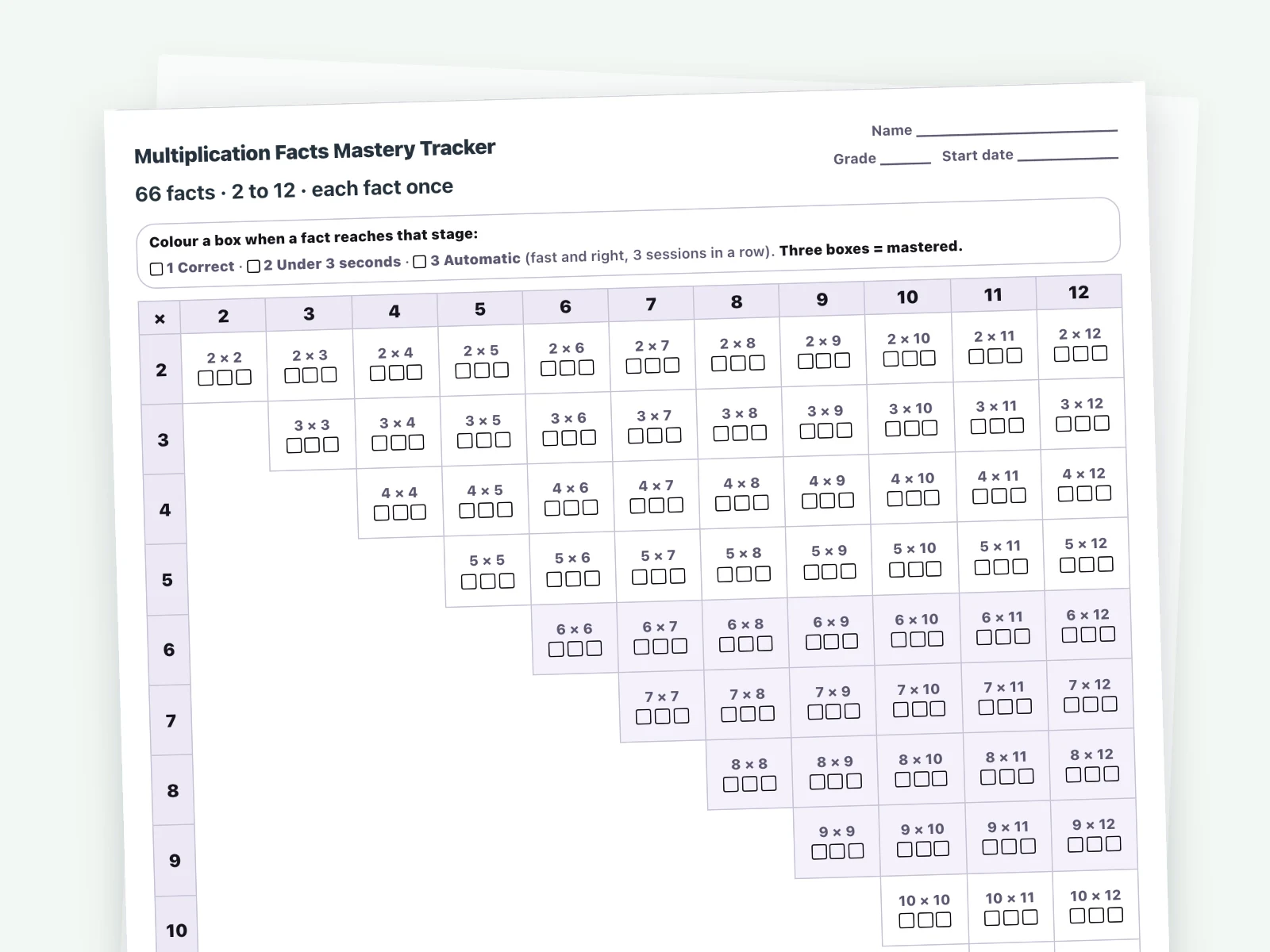
Generate Your Multiplication Facts Tracker
Fact range
Use 0–10 for Grade 3 or 0–12 for Grade 4 review. 2–12 is the 66 facts that need practice.
Layout
Each fact appears once, so 3 × 4 and 4 × 3 share a cell. 66 facts.
Multiplication Facts Mastery Tracker
66 facts · 2 to 12 · each fact once
| × | 2 | 3 | 4 | 5 | 6 | 7 | 8 | 9 | 10 | 11 | 12 |
|---|---|---|---|---|---|---|---|---|---|---|---|
| 2 | 2 × 2 | 2 × 3 | 2 × 4 | 2 × 5 | 2 × 6 | 2 × 7 | 2 × 8 | 2 × 9 | 2 × 10 | 2 × 11 | 2 × 12 |
| 3 | 3 × 3 | 3 × 4 | 3 × 5 | 3 × 6 | 3 × 7 | 3 × 8 | 3 × 9 | 3 × 10 | 3 × 11 | 3 × 12 | |
| 4 | 4 × 4 | 4 × 5 | 4 × 6 | 4 × 7 | 4 × 8 | 4 × 9 | 4 × 10 | 4 × 11 | 4 × 12 | ||
| 5 | 5 × 5 | 5 × 6 | 5 × 7 | 5 × 8 | 5 × 9 | 5 × 10 | 5 × 11 | 5 × 12 | |||
| 6 | 6 × 6 | 6 × 7 | 6 × 8 | 6 × 9 | 6 × 10 | 6 × 11 | 6 × 12 | ||||
| 7 | 7 × 7 | 7 × 8 | 7 × 9 | 7 × 10 | 7 × 11 | 7 × 12 | |||||
| 8 | 8 × 8 | 8 × 9 | 8 × 10 | 8 × 11 | 8 × 12 | ||||||
| 9 | 9 × 9 | 9 × 10 | 9 × 11 | 9 × 12 | |||||||
| 10 | 10 × 10 | 10 × 11 | 10 × 12 | ||||||||
| 11 | 11 × 11 | 11 × 12 | |||||||||
| 12 | 12 × 12 |
Facts automatic this week
Next 5 facts to work on
Take a weekly fluency check.
Pair the tracker with the 1-minute multiplication timed test or the 40-fact multiplication practice check.
How to Use the Tracker
- Print the tracker and tape it where the kid will see it daily — fridge, desk, inside their math folder.
- Run a 2-to-5-minute spaced repetition session every day. The app records per-card response times silently.
- Once a week (Friday works well), colour the boxes: the first when a fact is right, the second when it comes in under 3 seconds, the third when it has been fast and right three sessions in a row. Write the week's count of automatic facts in the weekly strip and the next five facts to work on.
- Watch the grid fill in. Most 3rd graders complete the 2-12 grid in 6 to 12 weeks. Slower fillers usually point to a missed-day pattern — extend the timeline, do not double the session length.
PDF Tracker or Spreadsheet?
Use this page when you want a clean printable mastery grid for a math folder, fridge, binder, or tutoring notebook. Pick the fact range, then use your browser's print dialog to print on paper or save the same tracker as a PDF.
A spreadsheet is better if you need formulas, class-wide sorting, or digital score calculations. This tracker is intentionally simpler than that: one page, three boxes per fact, a weekly count, and a clear record of which multiplication facts are automatic.
The Mastery Bar Used Here
"Mastered" on this tracker means automaticity, not accuracy:
- Answered correctly
- In under 3 seconds
- For 3 sessions in a row
That is a stricter bar than most school assessments use. For why it matters, read how to build math automaticity — the gap between fluent and automatic is what breaks long multiplication a year later.
Pair It With These
For the reference sheet that lives next to the tracker, grab the multiplication table generator. For a fixed timeline, the 30-day plan gives a week-by-week schedule. For the underlying method see spaced repetition for math facts.
Practice the table you are tracking, online:
Frequently Asked Questions
Right here. Set your fact range above, then press "Print or Save as PDF". Your browser opens its print box, and you choose "Save as PDF" to keep the file. You do not need an account or an email address.
It is a printable grid of every multiplication fact, with three boxes under each one: correct, under 3 seconds, and automatic. Your child colours a box as the fact reaches each stage. One glance shows which facts are locked in, which are close, and which are still slow.
Yes. Everything on this page prints for free, with no account, no email gate, and no watermark on the grid itself.
No. It is a printable PDF-style tracker you can customize by fact range, then print or save from your browser. Use it when you want a simple paper grid instead of a spreadsheet file.
Yes. Set the range to 0-12 for a 4th grade multiplication review. Each mastered multiplication fact also supports its inverse division fact family, although this printable grid records multiplication equations rather than separate division equations.
Colour the first box when the answer is right, the second when it comes in under 3 seconds, and the third when it has been fast and right for three sessions in a row. Three boxes coloured means mastered. Anything less is fluent, not yet automatic; the tracker is for automaticity, not just accuracy.
Once a week is the sweet spot. Daily updates create graph-watching pressure; less than weekly and the kid loses the dopamine of visible progress. Friday after the weekly fluency check is a clean cadence.
Most 3rd grade plans use a 0-10 multiplication range, while 4th grade review often uses 0-12. The sheet opens on 2-12, the 66 facts that actually need practice, and you can choose any range from 0-20 for a narrower intervention or extended fluency practice.