

Why split a multiplication fact?
Say you have 2 trays with 6 cookies on each. How many cookies do you have in all? If you get stuck, split the cookies on each tray into two smaller groups: 3 and 3. Now each part is 2 × 3. That is easier than 2 × 6. Add the two answers to get the total.
Start with 2 × 6
Two trays hold 6 cookies each. Split the cookies on each tray into 3 on the left and 3 on the right. Both parts still have 2 rows. Watch the split, then find each part.
Split 6 into 3 + 3
- 6 = 3 + 3
- 2 × 6 = 2 × (3 + 3)
- 2 × 6 = 2 × 3 + 2 × 3
Two parts make the whole. Find each part, then add.
Check the explanation and answers
Each part is 2 × 3 = 6. Add the two parts: 6 + 6 = 12 cookies.
Two equal parts
- 2 × 6 = 12
- 2 × (3 + 3) = 12
- 2 × 3 + 2 × 3
- 6 + 6 = 12
The parentheses show the two parts of 6. Multiply 2 by each part, then add the two totals. Now try a split with different-sized parts.
Now try 4 × 7 with four trays
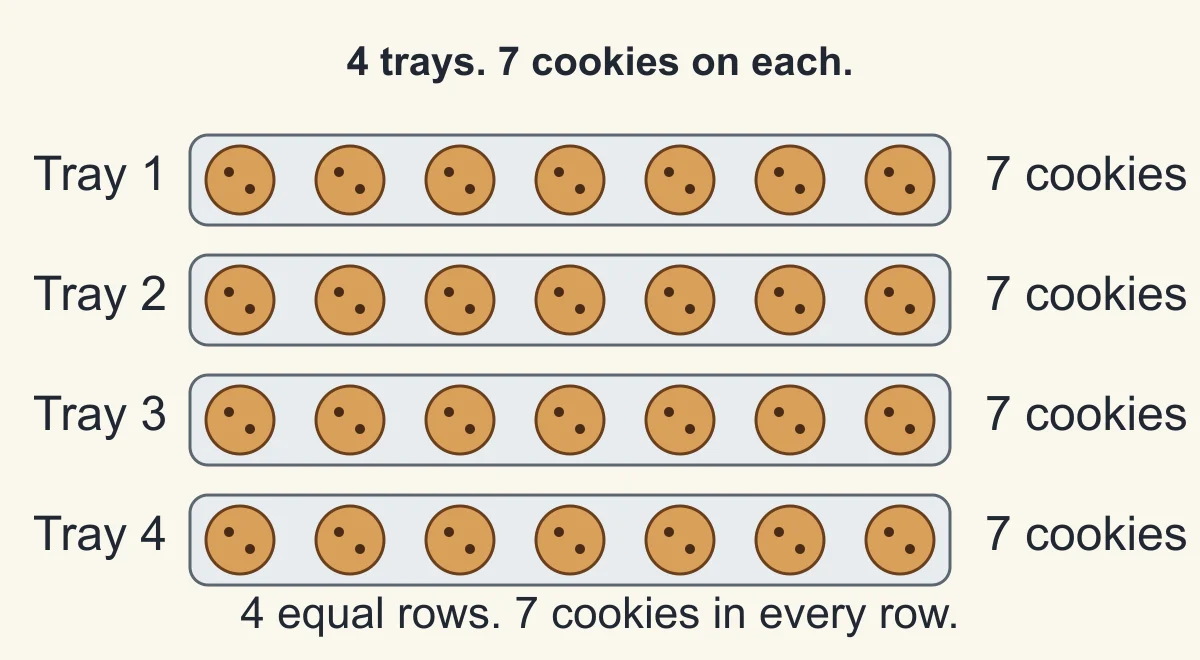
A baker has four long baking trays. Each tray holds 7 cookies in a straight row. That is 4 rows of 7, or 4 × 7. If you do not know this fact yet, you can break it into two facts you do know.
How do I split the trays into two easier facts?
Keep the same 4 trays. Draw a line after the fifth cookie on every tray. Now each tray has 5 cookies and 2 cookies.
Find each part first: 4 × 5 and 4 × 2. Then add your two answers and enter the result in the Total box. You can replay the split to see how the two parts fit together.
Split 7 into 5 + 2
- 7 = 5 + 2
- 4 × 7 = 4 × (5 + 2)
- 4 × 7 = 4 × 5 + 4 × 2
Two parts make the whole. Find each part, then add.
Check the explanation and answers
Find the first part: 4 × 5 = 20. Find the second part: 4 × 2 = 8. Add the two parts: 20 + 8 = 28 cookies.
What are the words and the equations?
In 4 × 7, the numbers 4 and 7 are the factors. The numbers 20 and 8 are products. They are the totals of the two parts. The rule that lets you split a factor this way is called the distributive property. The same 4 rows are counted in both parts.
4 × 7 = 4 × (5 + 2)
Two parts make the whole
- 4 × 7 = 28
- 4 × (5 + 2) = 28
- 4 × 5 + 4 × 2
- 20 + 8 = 28
The parentheses keep the numbers in each part together. Say it in your own words: multiply each part, then add.
Can you break apart a new fact?
A gardener has 3 rows of seedlings with 8 seedlings in each row. Split each row of 8 into 5 and 3. Work it out on paper first.
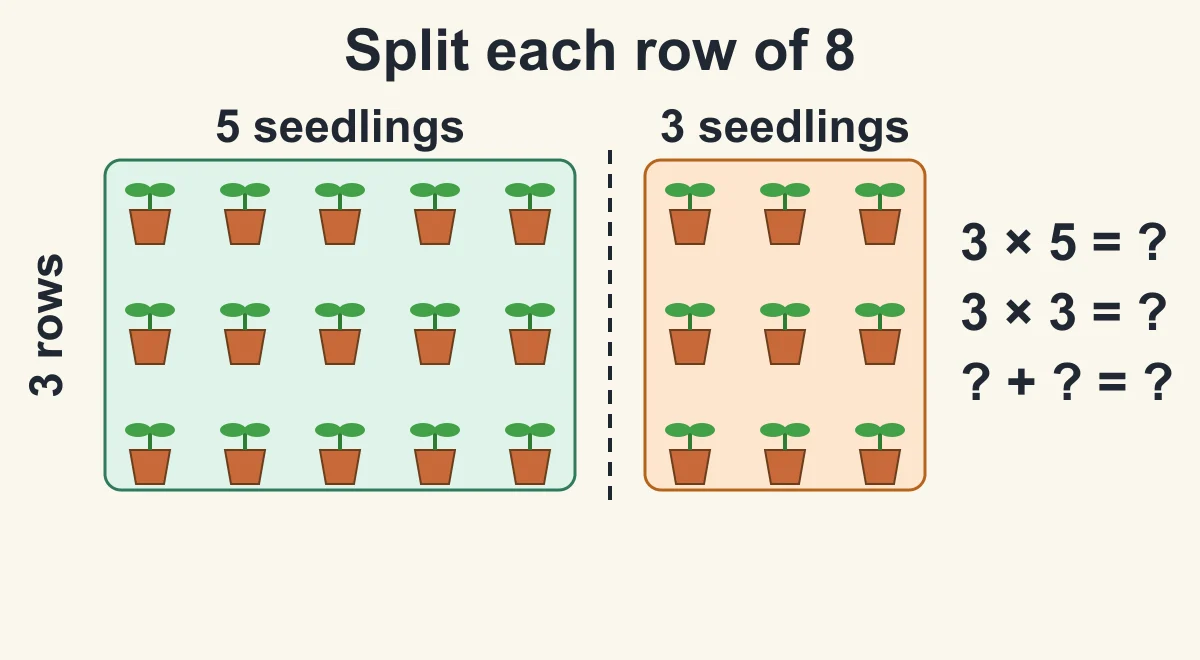
How many seedlings are in the left part? How many are in the right part? How many seedlings are there in all?
Extra challenge: find 6 × 9 by splitting 9 into 5 + 4. The answers are further down the page.
Questions about breaking apart a fact
What is the most common mistake?
Some people write 4 × 5 + 2 = 22. That counts only 2 extra cookies for all the trays. But each of the 4 trays has 2 extra cookies. Add 4 × 2 = 8, not 2: 20 + 8 = 28.
Can I choose another split?
Yes. Any split works if the parts add back to the factor you split. For 4 trays of 7, try 7 = 4 + 3: 4 × 4 = 16 and 4 × 3 = 12, so 16 + 12 = 28. Pick the parts you know best. Splitting off a 5 is often easiest.
Check your answers
Seedlings: the left part is 3 × 5 = 15. The right part is 3 × 3 = 9. In all, 15 + 9 = 24 seedlings.
Extra challenge: 6 × 5 = 30 and 6 × 4 = 24, so 30 + 24 = 54. That means 6 × 9 = 54.
Where can I get a break-apart worksheet with answers?
Print six different questions: a guided cookie split, a seedling split, a missing part, a mistake to fix, your own split to draw, and a new cookie story. Each PDF has a student page and a separate answer key.
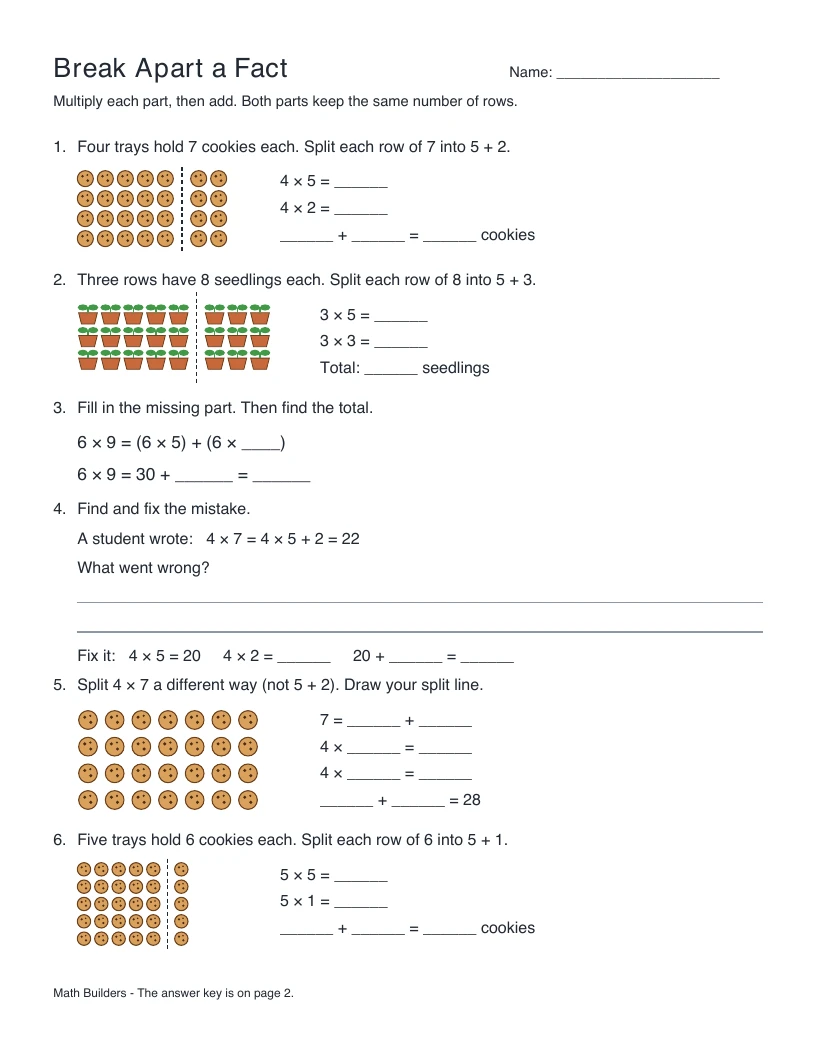
Download the worksheet and answer key (US Letter PDF)
Download the worksheet and answer key (A4 PDF)
Print at actual size. Try all six questions first, then check your work with the answer key.
Plan short multiplication practice
Use the Math Builders quiz to plan practice for your child or class.
Notes for parents and teachers
Start with real objects. Lay out 4 rows of 7 coins or cereal pieces, then place a pencil from top to bottom between the fifth and sixth columns. Ask how many are on each side and how you know. If a child writes 20 + 2, ask them to count the objects right of the pencil.
Children do not need to use or memorize the term distributive property. Being able to explain the split matters more. Let them choose a split they find easy, then try a fresh fact without hints.
Review rows and columns in multiplication arrays, or connect facts with multiplication and division fact families. For short recall practice, go back to the multiplication fact fluency guide.
More rules of multiplication: the zero property of multiplication and the identity property of multiplication.
Teaching connections: Common Core 3.OA.B.5 describes using properties of operations as strategies to multiply.
Array background: TERC Investigations notes on array representations.