
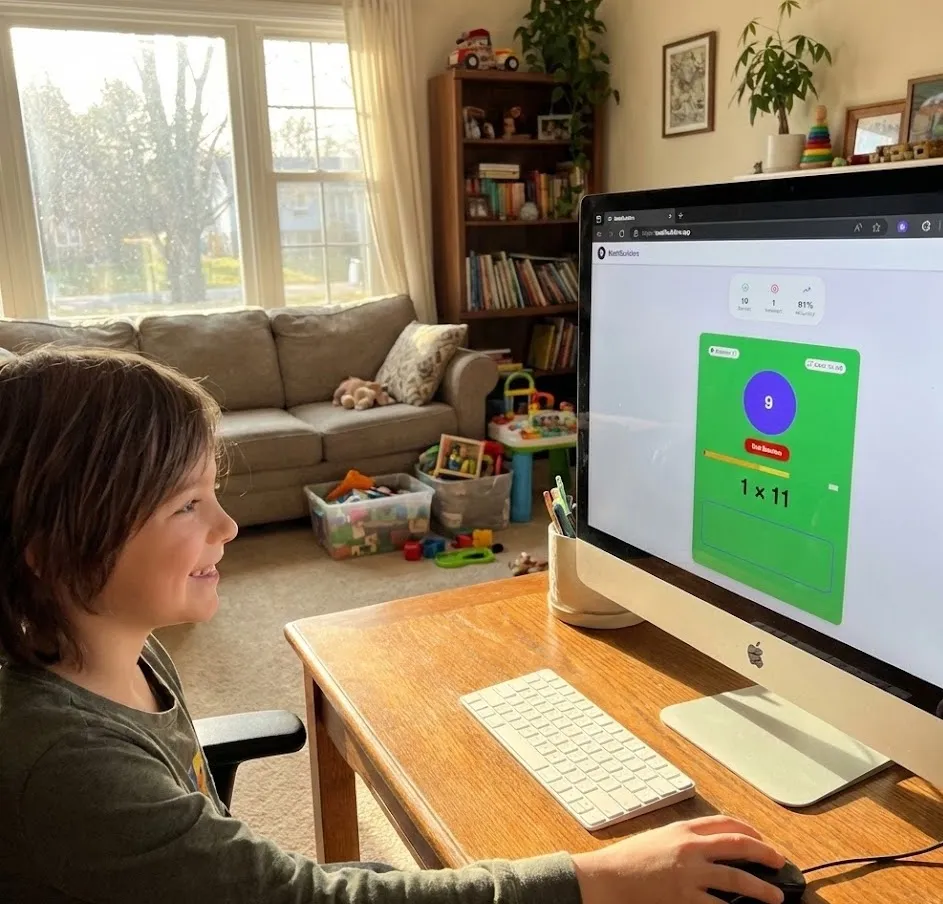
What 3rd Grade Fluency Looks Like
By the end of 3rd grade, Common Core 3.OA.C.7 calls for fluent multiplication and division within 100. Addition and subtraction within 20 should stay available for later work. Look for accurate answers first, then for recall that does not need repeated counting.
- Multiplication
Products of two one-digit numbers are recalled accurately without rebuilding each answer.
- Division
Related division facts are solved from the same multiplication fact families.
- Addition and subtraction within 20
Should already be in long-term memory from 2nd grade. Add quick weekly check-ins.
Start Here: Check and Practice
Use one route at a time. Check what is ready, choose the practice format that fits the child, and practice only the facts that still need work.
3rd grade readiness test
Use a short mixed check to find the multiplication facts that are not fluent yet.Practice on paper3rd grade math printables
Choose a grade-level sheet when a child needs pencil-and-paper practice.Practice onlineMultiplication facts practice
Run a 40-fact check and identify the missed or over-3-second facts.The 3rd Grade Fact Sequence
Do not make every operation compete for attention in one session. Use this order, then keep earlier facts in brief mixed review.
- 1. Maintain addition and subtraction within 20
Check these facts once a week. If counting returns, repair this foundation before adding a larger multiplication load.
- 2. Build multiplication meaning
Connect equal groups, arrays, and repeated addition before recall practice.
- 3. Practice multiplication fact families
Start with 2s, 5s, and 10s, then add the facts the child can explain but cannot recall quickly.
- 4. Add related division facts
Use each known multiplication family to answer both related division facts, then mix the operations.
The 2-to-5-Minute Daily Plan
One session, every day. Same time each day, ideally before something the kid likes.
- First minute
Warm-up. 15 to 20 facts the child already owns. Build momentum.
- Middle 1 to 3 minutes
Focus set. The 5 to 8 slow facts from yesterday. Repeated retrieval until each one drops under 3 seconds.
- Final 30 to 90 seconds
Mixed sprint if time remains. Include one or two facts from last week to test that the spacing held.
A Sequence You Can Pace
Move forward when the current set is accurate. The stages are an order, not a promise that every child will finish on the same calendar.
- Stage 1: 2s, 5s, and 10s
Use the clear skip-counting patterns to connect equal groups with products.
- Stage 2: 0s, 1s, and 11s
Add the identity and pattern facts without dropping mixed review from Stage 1.
- Stage 3: 9s and square facts
Use patterns as an entry point, then confirm that the answer can be recalled without the pattern.
- Stage 4: 3s, 4s, 6s, 7s, and 8s
Narrow practice to the facts that stay slow, and space their return across later sessions.
- Stage 5: Mixed practice and related division
Mix the fact families only after the child can explain how multiplication and division are connected.
Common 3rd Grade Trouble Spots
- 6s, 7s, 8s
These facts have fewer obvious patterns. Keep the set small and return to missed facts on later days.
- Confusing fact families
6×7 = 42, 7×6 = 42, 42÷6 = 7, 42÷7 = 6. Teach all four together so the child sees the structure.
- Math anxiety from timed tests
Reframe: the timer is for the facts, not the kid. Track personal bests, not class rank.
Signs Recall Is the Bottleneck
A child can understand multiplication and still spend too much working memory rebuilding facts. Recall practice is the next step when the child can explain the model but does one or more of these:
- Skip-counts from the beginning for a fact seen many times
- Answers accurately but pauses long enough to lose the next step of a word problem
- Knows a product but cannot use it to answer the related division fact
- Misses the same small group of facts across several practice days
If the child cannot explain what multiplication means, pause the speed work. Return to arrays, equal groups, and manipulatives. If the model is clear, practice only the slow or missed facts for 2 to 5 minutes, then check them again on another day.
Learn the Practice Method
For the underlying method, see multiplication fact fluency. For the parent strategy guide, see how to memorize multiplication tables. If the same facts keep disappearing between practice days, use the spaced repetition math facts schedule. If you are comparing practice apps for a 3rd grader, use the multiplication app buyer's checklist to check for short sessions, weak-fact review, and recall timing before you pick one. For a weekly paper record, print the free multiplication facts mastery tracker. When you are ready to put this into action, start a 2-to-5-minute session in Math Builders.

Frequently Asked Questions
By the end of 3rd grade, students should be fluent in multiplication and division within 100. Continue to review addition and subtraction within 20 so those earlier facts stay available.
Start with 2 to 5 focused minutes a day. Stop while the child can still answer carefully, and use the next session for the facts that were missed or slow.
Drop the test framing. Use a timer to measure individual facts (under 3 seconds = known), not as a pass/fail event. The number on the screen is a diagnostic, not a grade.
Yes, when they are adaptive. The right app spends most of the practice time on the few facts the child is slow on, instead of cycling all 100 facts every session.