
Help multiplication facts stick in 2 to 5 minutes a day.
Math Builders gives your child a short, focused practice loop: warm up, work the slow facts, then bring them back with spaced review. It is free to start and built to work alongside school math.
No credit card required
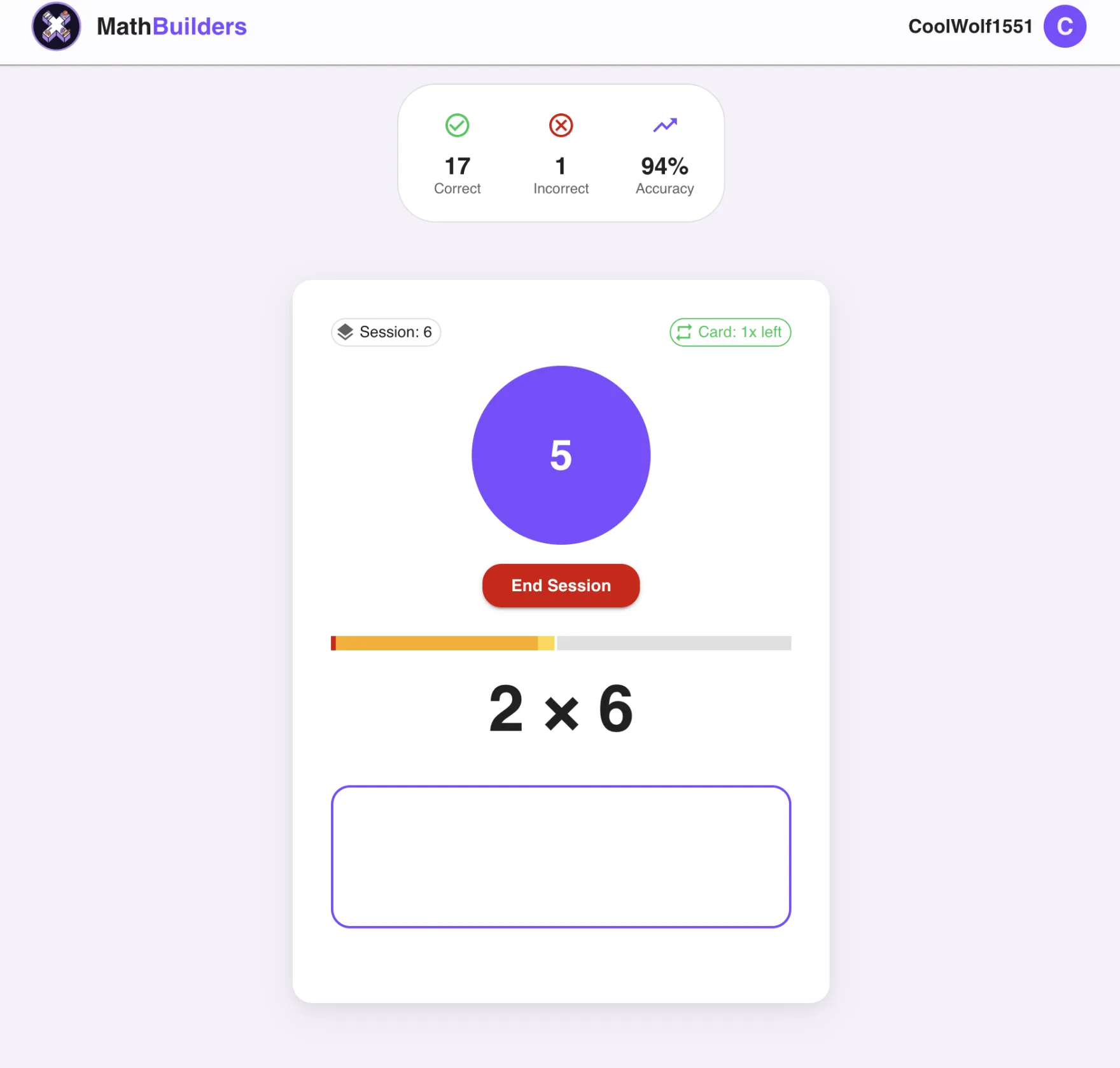
First session: 4 cards
Supplement, not curriculum
Step 1
Start with the facts they already know
0s, 1s, 2s, 5s, and 10s create quick wins and lower resistance before the harder 6s, 7s, and 8s show up.
Step 2
Practice the slow facts daily
The point is not more minutes. It is spending the next few minutes on the facts that are almost there but not automatic yet.
Step 3
Let spacing do the heavy lifting
Facts return today, tomorrow, and later, so a fact that looked learned in May does not disappear by September.
The multiplication problem most parents are actually solving
A lot of kids understand what multiplication means before the facts are automatic. They can work out 6 x 7, but it takes counting, pausing, or rebuilding the fact from scratch. That is not a concept problem. It is a recall problem.
Math Builders is made for that middle stage. It works alongside school math by turning the facts that almost stick into a daily routine your child can actually finish.
A summer multiplication routine families actually keep
Late spring and summer are when a lot of multiplication progress quietly slips. The fix is usually not more work. It is a routine light enough to survive camp weeks, travel days, and the general messiness of June and July.
- Pick one repeatable window, like after breakfast or before screen time, and keep it to 2 to 5 calm minutes.
- Use practice the child can exit without a fight so one rough day does not turn into a lost week.
- Keep known facts and slow facts mixed together so September does not start with a full rebuild.
If you want the exact structure, start with the 5-minute math practice routine, pair it with no-pressure practice, and use the forgetting curve guide if you need to explain why tiny daily reps beat a longer catch-up session. If you are choosing the tool for that routine, use the best multiplication app checklist to compare adaptive apps, flashcards, and worksheet-heavy practice.
What the 2-to-5-minute routine does
- Warms up with facts your child already owns so the session starts with momentum.
- Finds the facts that are correct but slow, then brings them back sooner.
- Keeps missed facts in light rotation instead of marking them done forever.
- Lets the child stop without losing progress, which makes tomorrow easier to start.
Proof that answers the parent question: will this actually help?
The app is intentionally narrow. It does not try to become another curriculum, reward platform, or homework portal. It focuses on the fluency layer.
Short by design
The first session is only 4 cards. Regular practice is built around a calm 2-to-5-minute routine.
Measures fluency
Fast correct answers and slow correct answers are treated differently, because both matter.
Core practice stays free
No credit card required. One learner can keep using all six individual core fact packs—the complete fact foundation across all four operations—and basic progress tracking for free.
When to move from understanding to fluency
Keep using arrays, skip-counting, and teacher methods while a fact is still new. Once your child can explain why 5 x 5 = 25, the next goal is speed. Fluency means the answer arrives fast enough that it does not steal attention from harder work.
For the science behind that shift, read the math fact fluency guide or the 5-minute math practice routine.
Frequently Asked Questions
Keep the routine short, start with easy-win facts, and move from understanding to quick recall gradually. A focused 2-to-5-minute session is easier to repeat than a long worksheet block.
For fact fluency, yes. Daily spacing matters more than one long weekly session because the brain needs time between reviews to keep facts accessible.
Use a small daily routine instead of a once-a-week catch-up block. Two to five calm minutes keep retrieval active, prevent September rebuild mode, and are much easier for families to maintain across camps, trips, and uneven summer schedules.
No. Math Builders is a fluency layer. School teaches the concept; Math Builders helps facts become automatic enough for fractions, area, and long division.
That is exactly the fluency gap. Math Builders treats a slow correct answer differently from a fast one, so facts that need more retrieval practice come back sooner.
Try the first session while the idea is fresh.
Your child can start free, answer a few cards, and see whether the short routine feels doable today.
Try a 10-card sample