
What "Automaticity" Actually Means
Automaticity is a pedagogical term with a specific definition: the ability to retrieve a known fact without conscious effort, fast enough that no working memory is consumed by the retrieval. For arithmetic the operational threshold most researchers (and the Common Core standards in spirit) use is under 3 seconds, applied to every single-digit fact, mixed and unprompted.
Three terms get mixed up in classroom and parent conversations. They are not the same thing:
- Accuracy
The kid gets it right. Says nothing about speed.
- Fluency
The kid gets it right, reasonably quickly, with at most a brief pause. Still some conscious effort in the retrieval.
- Automaticity
The kid gets it right instantly, with zero conscious effort. The answer is there before the problem finishes being read.
The gap between fluency and automaticity is where the work actually happens — and where most school math stops short. Curriculum standards (CCSS, state standards, NCTM) consistently name automaticity as the goal for the end of 3rd grade, but most assessments only measure accuracy. So a kid who is fluent at 90 seconds on a 40-fact mixed sheet looks fine on paper, and the missing automaticity quietly breaks long multiplication, division, and fractions a year later.
Step 1: Establish the Baseline
Time the child on 40 mixed facts from 0 × 0 through 12 × 12. The number you want is total time, not accuracy. Under 60 seconds at 95 percent or higher is the automaticity bar. Most kids you would describe as "they know their facts" land at 90 to 120 seconds — fluent, not automatic.
Whatever the time is, that is the baseline. Everything from here is improving on that number.
Step 2: Set the 3-Second Rule
On every individual fact, the question is binary: did the answer come in under 3 seconds, or not?
- Under 3 seconds + correct
Known. Push the spaced interval out.
- 3 to 10 seconds + correct
Reconstruction. Hold the spaced interval flat.
- Over 10 seconds OR wrong
Reset. Show again this session and tomorrow.
Step 3: Run a 2-to-5-Minute Spaced Session Daily
The math here is not about how much practice. It is about how often and at what spacing. A 2-to-5-minute session every day produces roughly 4x the retention of a 35-minute session once a week, for the same total practice minutes per week.
The session should pull only due facts — the ones whose interval has expired since their last successful recall. That keeps the 2-to-5-minute slot dense with work, not full of already-easy facts.
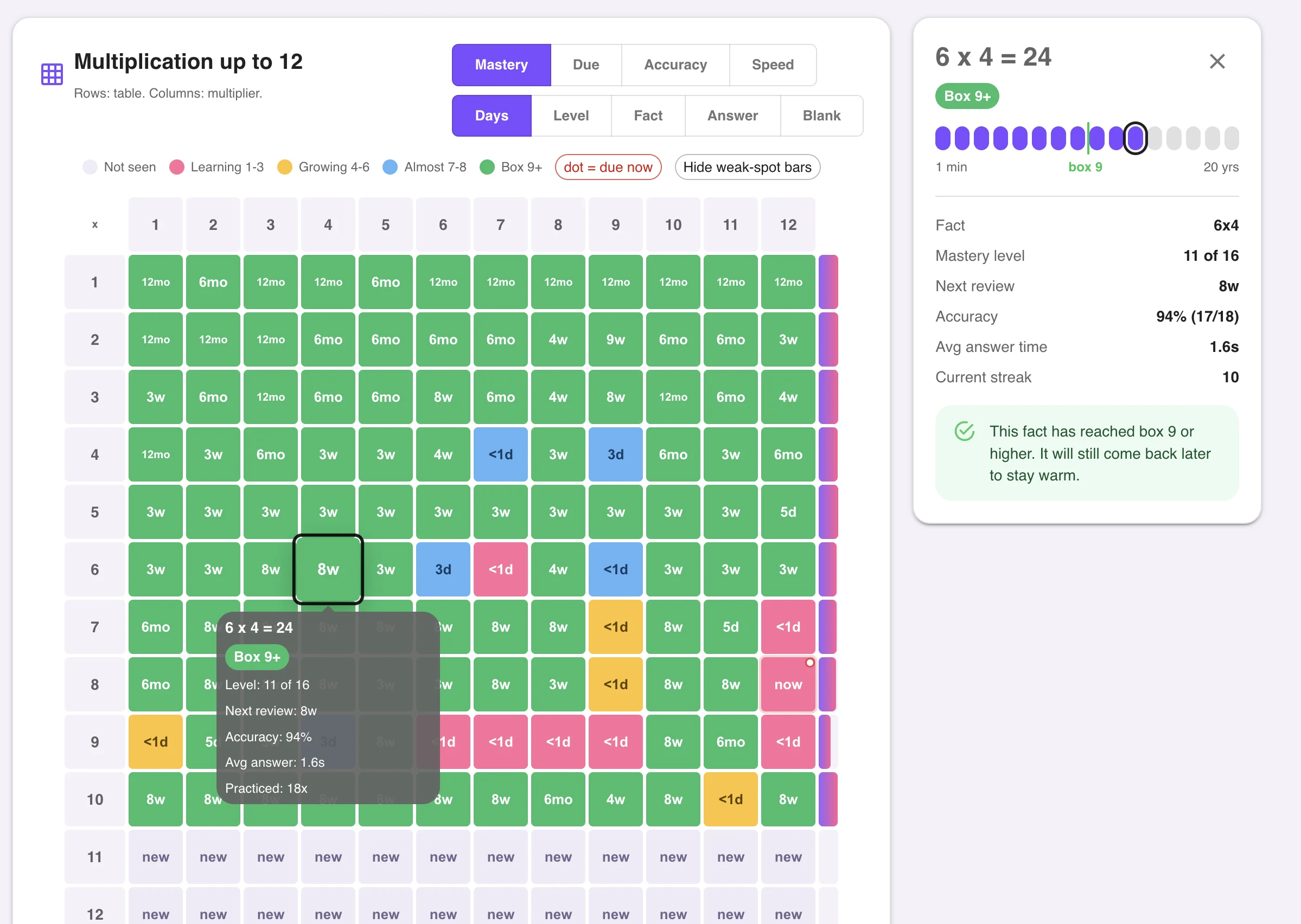
Step 4: Use SRS Scheduling for Every Fact
Each fact gets its own schedule based on its own history. Spaced repetition runs in the background; you do not need to think about it. For the underlying mechanism see spaced repetition for math facts. For the Anki comparison see Anki-style multiplication practice.
Step 5: Confirm With a Weekly Fluency Check
Once a week, rerun the 40-fact timed sheet from step 1. The score is the proof. You want a clean downward curve over 6 weeks: 120s → 105s → 90s → 75s → 65s → 60s. If it stalls, two things to check: are the sessions actually happening daily, and are the misses being properly reset to today.
What the End State Feels Like
A kid with automaticity does not look like a kid solving math. They look like a kid reading. The answer is there before the problem finishes being asked. That is the gap closing between short-term reconstruction and long-term memory. Once it lands, it stays — and every harder topic gets easier overnight.
For a deeper look at automaticity vs fluency see math fact fluency. To start a session, open the practice page — the 3-second rule and SRS scheduling are already wired in.
Frequently Asked Questions
Automaticity is the ability to retrieve a fact in under 3 seconds without conscious effort. A child who has to skip-count or reconstruct 7 × 8 is fluent but not automatic. Automaticity is what frees up working memory for multi-step problems like long multiplication, fractions, and algebra.
Fluency means the child can answer correctly with some hesitation. Automaticity means the answer fires instantly, like a reflex. Fluency is the gateway; automaticity is the destination. Most state standards (and the CCSS) call for automaticity by end of 3rd grade.
Yes — SRS is currently the most efficient known method. Spaced repetition gets each fact into long-term memory; a response-time threshold (3-second rule) confirms the recall is automatic, not reconstructed. Combine the two and you get the shortest path from learning to reflex.
With 2 to 5 minutes a day, most kids reach automaticity on multiplication 0-12 in 6 to 12 weeks. Older kids who already have partial fluency are usually faster. Kids who have been doing worksheets for a year often hit it in 4 weeks once the method changes.
It is worth chasing. Studies on math performance consistently show that kids without automaticity hit a wall in 4th and 5th grade — long multiplication and division require so many fact lookups that the slow-but-correct kid runs out of working memory mid-problem. The lookup cost compounds.