
Build your sheet
Pick a picture
Picture collection
Two pages: the worksheet, then the answer key.
One picture, any fact set
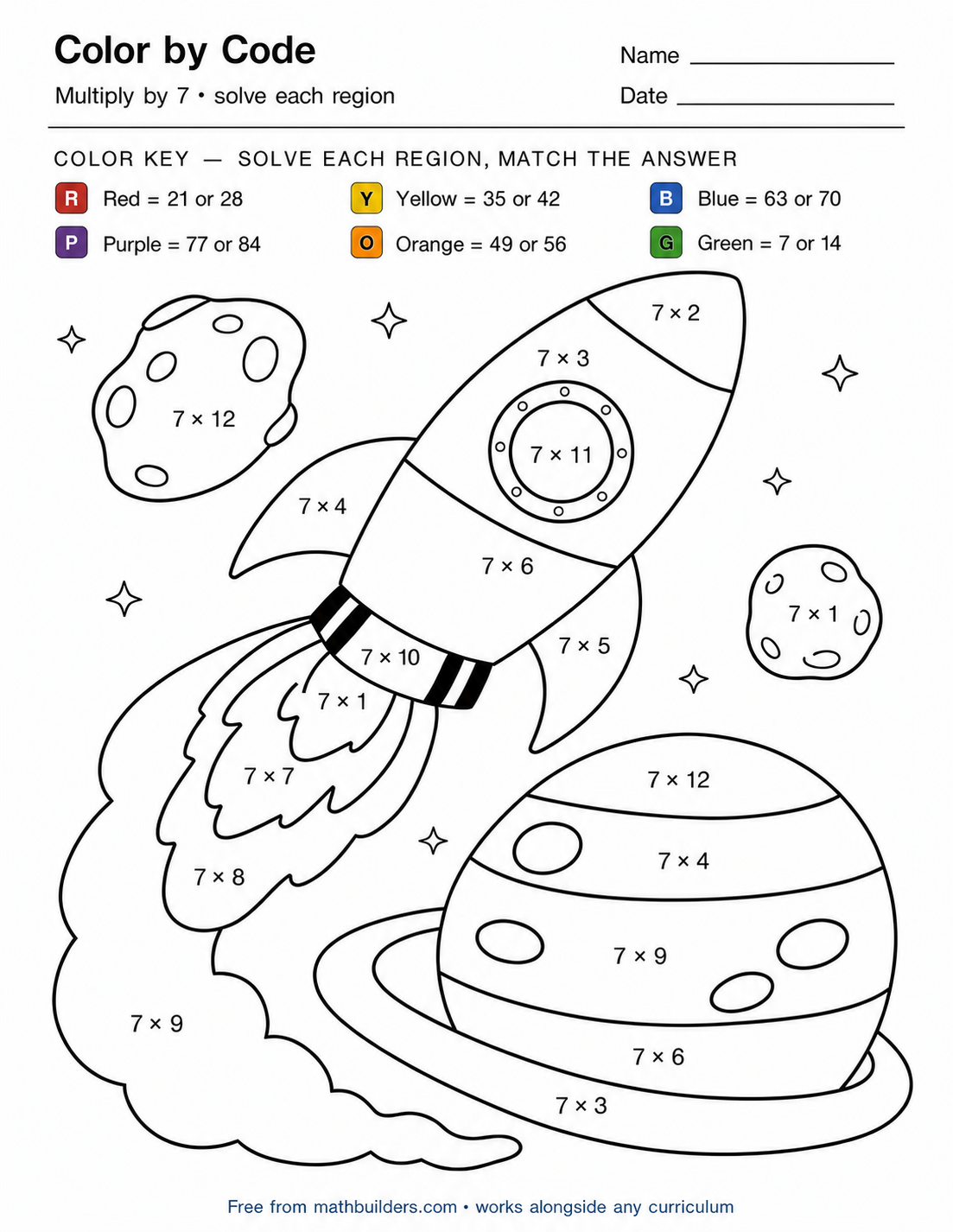
Differentiation on a color by code sheet is usually a shopping problem: one pack per table, one pack per operation, and nothing at all for the child who is still on addition. Here the picture and the fact set are separate choices, so the group can color the same rocket while three children are working on Multiply by 7, Divide by 3, and Addition to 10.
Currently showing Multiply by 7 on 16 pictures. There is also a dedicated page for this fact set: 7 Times Table Color by Number Worksheet.
Color by code worksheets by fact set
Each fact set below has its own printable page with a default picture, the same switcher, and a link to matching online practice.
Where this fits
Coloring is slow, deliberate practice: twelve facts, a lot of thinking time per fact, and a finished thing to take home. It is a good first pass and a good way to sit with facts that are still shaky. It is not how recall gets fast — that comes from short, repeated retrieval, which is what the online practice does.
Color by code FAQ
Every region of the picture carries its own problem instead of a single number. The child solves the problem, finds the answer in the color key, and colors that region with the matching crayon. A finished picture is only correct if the facts were.
Multiplication tables 1 to 12, division by 1 to 12, addition to 10 or 20, and subtraction within 10 or 20. Pick the operation and fact set above and the sheet regenerates on any of the pictures.
Yes. Each color key swatch also shows a letter code (R, PK, O, Y, G, PG, B, P, L, BR, S, GY), and every code is contrast-checked against its own swatch, so a grayscale print is still usable.
Yes. Printing produces two pages: the worksheet first, then a filled-in answer key on its own page so you are not marking against a blank sheet.