
Games You Can Play Now
Both subtraction games below are free to play right now, in the browser, with no account and no download.
Two Fact Sets: Within 10 and Within 20
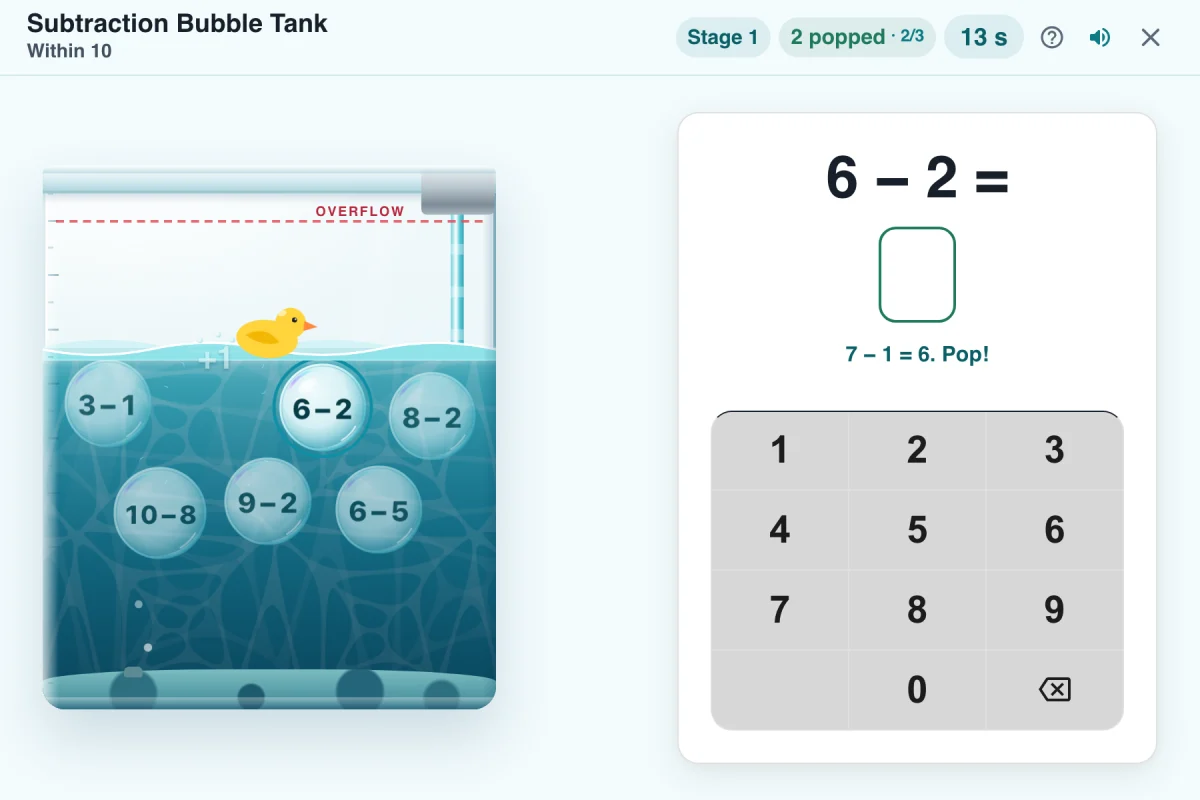
Bubble Tank offers two subtraction fact sets. Within 10 covers every take-away where the starting number is 10 or less and you remove anywhere from 1 up to one less than that starting number, so the difference always lands between 1 and 9 — facts like 9 − 4 or 6 − 2. Within 20 widens the range to the take-away partners of the sums-to-20 table: subtract anywhere from 1 to 10 and the difference itself runs 1 to 10, including 20 − 10 = 10. That set brings in teen minuends like 17 − 8, the pairs a first or second grader meets once addition to 20 is solid.
Pick within 10 for a kindergartner just starting to take numbers apart, and move to within 20 once the smaller set feels instant.
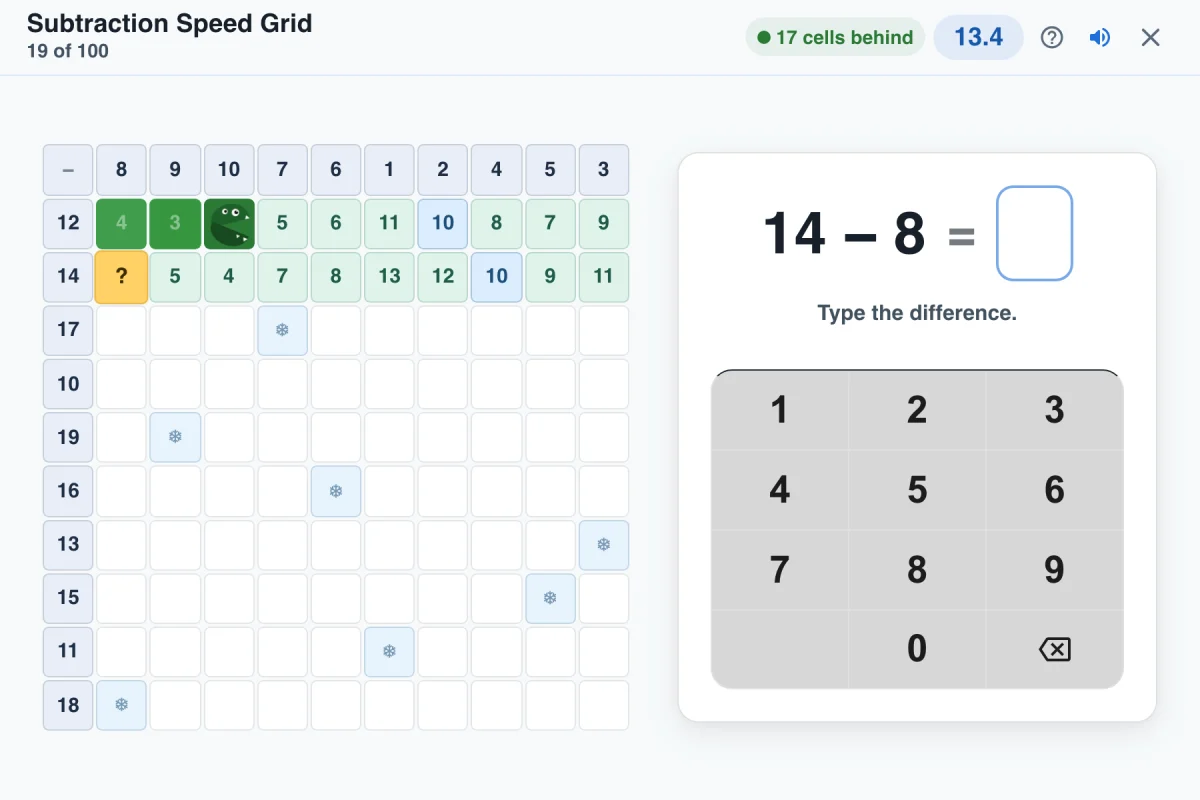
The Speed Grid has no fact-set switch. Its rows start at the grid size: take 1 through 10 away from 10 through 19 on the 10 × 10 grid, or 1 through 12 away from 12 through 23 on the 12 × 12 grid. It fits a child who is already quick within 20.
Subtraction Is a Missing Addend
Every subtraction fact hides an addition fact. 9 − 4 asks the same question as 4 + ? = 9, and a learner who has drilled addition to 20 already owns most of the answer before a single subtraction worksheet arrives. Both games lean on that link rather than fighting it: the fact sets mirror the addition sums-to-10 and sums-to-20 tables exactly, so a child moves from 6 + 3 = 9 to 9 − 3 = 6 along a path they have already walked, reading the same fact backward rather than learning a new one from nothing.
Why Counting Back Is Slow
Ask a child to solve 13 − 5 and a common first move is counting back on fingers: 12, 11, 10, 9, 8 — five taps for a five-step gap. It gets the right answer, and it gets there every single time a few seconds too late for a timed game or a multi-step problem. Recall replaces the count with a single stored fact: 13 − 5 is 8, retrieved the way a phone number is retrieved, not rebuilt on the spot. Bubble Tank and Speed Grid both put a small clock on that gap, so the fastest path to a high score is the fact remembered, not the fact worked out.
Games Alongside Practice and Worksheets
A game measures what is already fast; it does not build the fact in the first place. Pair a few rounds of Bubble Tank or Speed Grid with short, repeated practice and printable subtraction worksheets for the facts that are still slow, and the games become a way to feel the improvement rather than the only source of it.
For the fuller picture of how the two skills build together, read addition and subtraction fluency. Inside Math Builders, a slow subtraction fact returns on a spaced schedule until it is automatic; the games sit on top of that work, alongside it, never in place of it.
Games for the Other Operations
- Multiplication games
3 games
- Addition games
2 games
- Division games
1 game
Every game on Math Builders, for all four operations, is listed on the free math games page.
Frequently Asked Questions
Two. Subtraction Bubble Tank has you pop the glowing bubble’s difference before the rising water reaches the lid, and the Subtraction Speed Grid has you fill a shuffled grid one cell at a time while a snake follows the same path behind you.
Yes. Both run in the browser with no account, no download, and no in-app purchases. Signing in to Math Builders only saves practice progress; the games themselves need nothing.
Bubble Tank has two sets: within 10 (starting numbers of 10 or less, differences from 1 to 9) and within 20 (the take-away partners of the sums-to-20 table, differences from 1 to 10, including teen minuends like 17 − 8). Speed Grid is a table instead: take 1 to 10 away from 10 through 19 on the 10 × 10 grid, or 1 to 12 away from 12 through 23 on the 12 × 12 grid, so differences run from 0 up to 18 or 22.
Yes. Each one uses the same on-screen keypad Math Builders uses during practice, so it plays on a touch screen without opening the device keyboard. On a computer, type with the number keys.
No. A game rewards a fact you already know quickly; it does not teach a fact that is still missing. Use the games as the fast, fun test, and short practice or printable worksheets as the way a slow fact gets fixed.