
Why Kids Forget Facts That Look Learned
A worksheet can make a fact look learned because the answer is still sitting in short-term memory. The real test is whether the child can retrieve the fact days later, in a mixed set, without rebuilding it from skip-counting or a trick.
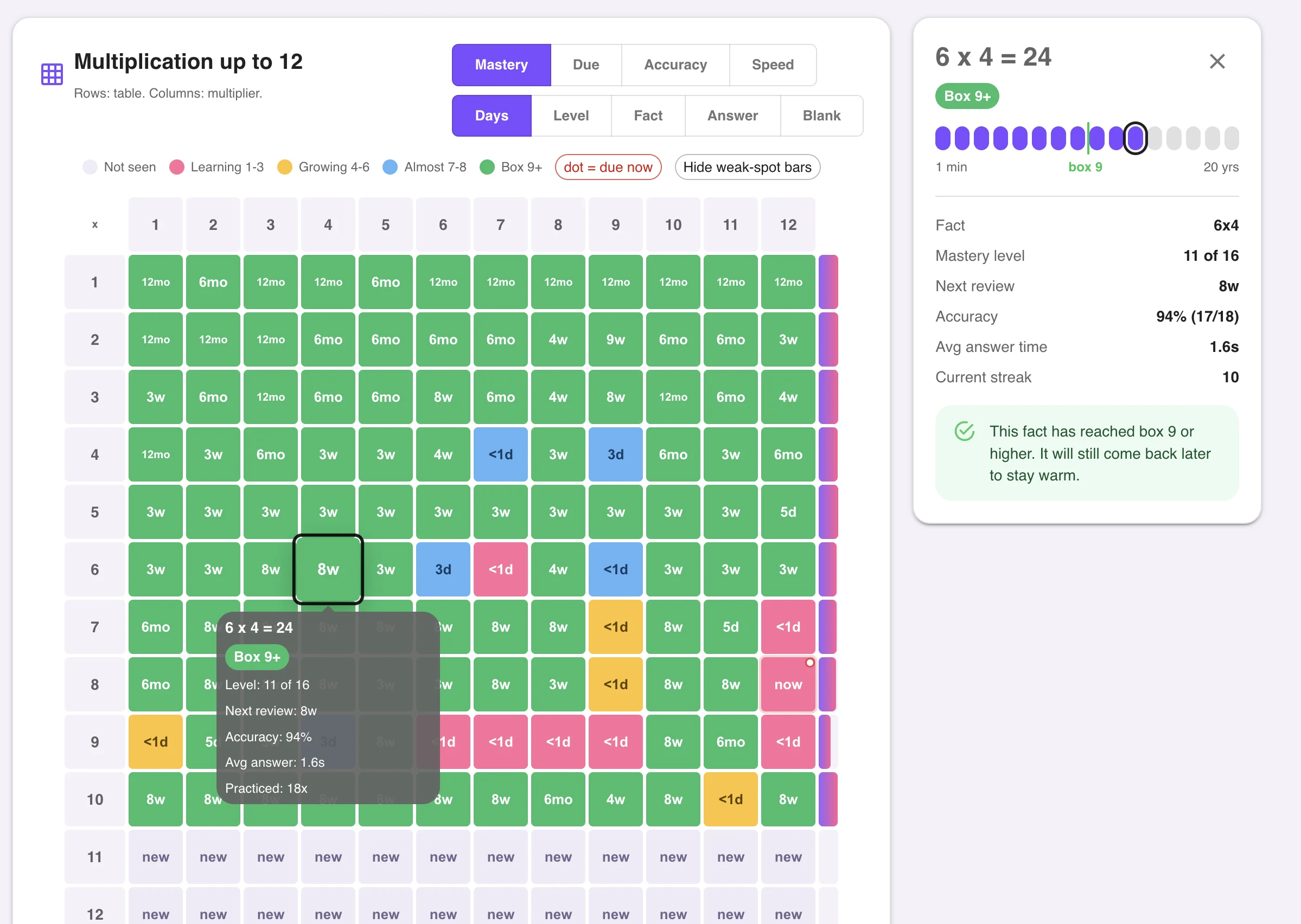
Spaced repetition solves that by bringing the fact back just before the memory fades. Each successful retrieval pushes the next review a little farther out. That is how a shaky fact becomes a durable one.
Not all spaced repetition systems are equal. The efficient version is time-aware: it schedules reviews near the forgetting curve, weighs response speed as well as accuracy, and avoids repeating facts just because a session needs more cards.
The 2-to-5-Minute Spacing Routine
Keep the routine small enough to repeat every day:
- Minute 1: warm-up
A few known facts to get the child into retrieval mode.
- Minutes 2 to 4: due facts
The facts that are due today because they were missed, slow, or last answered correctly several days ago.
- Final minute: quick retention check
Mix in one or two facts from last week so nothing disappears quietly.
The schedule matters more than the total minutes. A child will keep a short daily routine long enough for the spacing to work.
A Concrete Schedule to Use Near the Top
- Day 0: missed fact
Show it again before the session ends, then bring it back tomorrow.
- Day 1: correct but slow
Bring it back in 1 to 2 days because the answer still took effort.
- Day 1 or 3: correct and fast
Move it to 3 days, then 7 days, then 14 days, then 30 days.
- Any later miss
Reset the fact to today. The goal is durable recall, not pretending the miss did not happen.
This is the practical schedule most parents need. It is specific enough to use immediately, but short enough to keep the whole system from becoming homework management.
How Math Builders Uses Time-Aware Spaced Repetition
Math Builders combines spaced review with a 3-second recall bar. A fact answered quickly can move farther out. A fact answered slowly, even if correct, comes back sooner. A missed fact resets to the front of the line and shows up again before the child leaves the session.
The scheduler follows a Leitner / SM-2-style ladder, but it is tuned for math facts instead of adult self-graded flashcards. Accuracy decides whether a fact survived; response time decides whether the answer was automatic enough to wait longer.
That makes the practice feel different from a generic memory-science article. The child is not managing cards or calendars. They are just doing a short daily session while the scheduling happens in the background. Start a short session if you want to see the spacing in action.
Flashcards, Worksheets, Timed Routines, and Math Builders
- Plain flashcards
Useful for exposure, but they usually over-practice easy facts and under-schedule the weak ones.
- Worksheets
Good for showing volume, but most of the page is spent on facts the child already knows. They rarely bring old misses back at the right time.
- XtraMath-style timed routines
Helpful for daily consistency, but the fixed routine can still be too rigid for kids who need shorter stops and more visible weak-fact recycling.
- Math Builders
Short sessions, stop-anytime progress, and a queue that keeps returning the facts most likely to disappear next.
Where to Strengthen the Rest of the Practice Plan
If you are building the whole routine, pair this page with the math facts practice guide, the math fact fluency guide, and how to memorize multiplication tables. Those pages cover the daily habit, the 3-second bar, and the order to teach the harder facts.
For the deeper comparisons and adjacent science, also see spaced repetition vs traditional drills, Anki-style multiplication practice, and the forgetting curve in elementary math. If you are deciding which tool should run the routine, use the multiplication app buyer's checklist to compare adaptive apps against flashcards, worksheets, and game-heavy practice.

Frequently Asked Questions
Because most practice systems stop too early. A child can get a fact right on Friday and still lose it by Tuesday if the fact does not come back at the right spacing. Spaced repetition fixes that by reviewing just before the memory fades.
Yes. Math facts are a strong fit because they are short, exact, and easy to mix. The key is grading both correctness and speed, not just whether the child eventually got the answer.
A practical home schedule is: missed today, review again today; correct today, review tomorrow; then 3 days, 7 days, 14 days, and 30 days. Slow correct answers should come back sooner than fast correct answers.
For math facts, keep it to 2 to 5 minutes. That is long enough to hit the facts due today and short enough that the routine can repeat tomorrow, which is what makes the spacing work.
It can use flashcards, but the real value is the schedule. Plain flashcards usually show facts in a fixed order or random order. Efficient spaced repetition deliberately brings back the facts that are most likely to be forgotten next, which is why not all SRS systems are equal.