
Why Families Still Look Around
- Free does not help if the routine died
XtraMath can be the right tool and still fail in one household because the learner will not start again tomorrow. Math Builders is for that failure case.
- The child needs an exit, not another lecture
Math Builders is designed around short starts and saved progress, so a learner can stop after a small win instead of treating practice as all-or-nothing.
- Parents need the slow facts, not just a status
Parents, tutors, and teachers often need a quick way to see which facts are still missed or slow this week, not just whether practice happened.
- The real efficiency fight is timing plus consistency
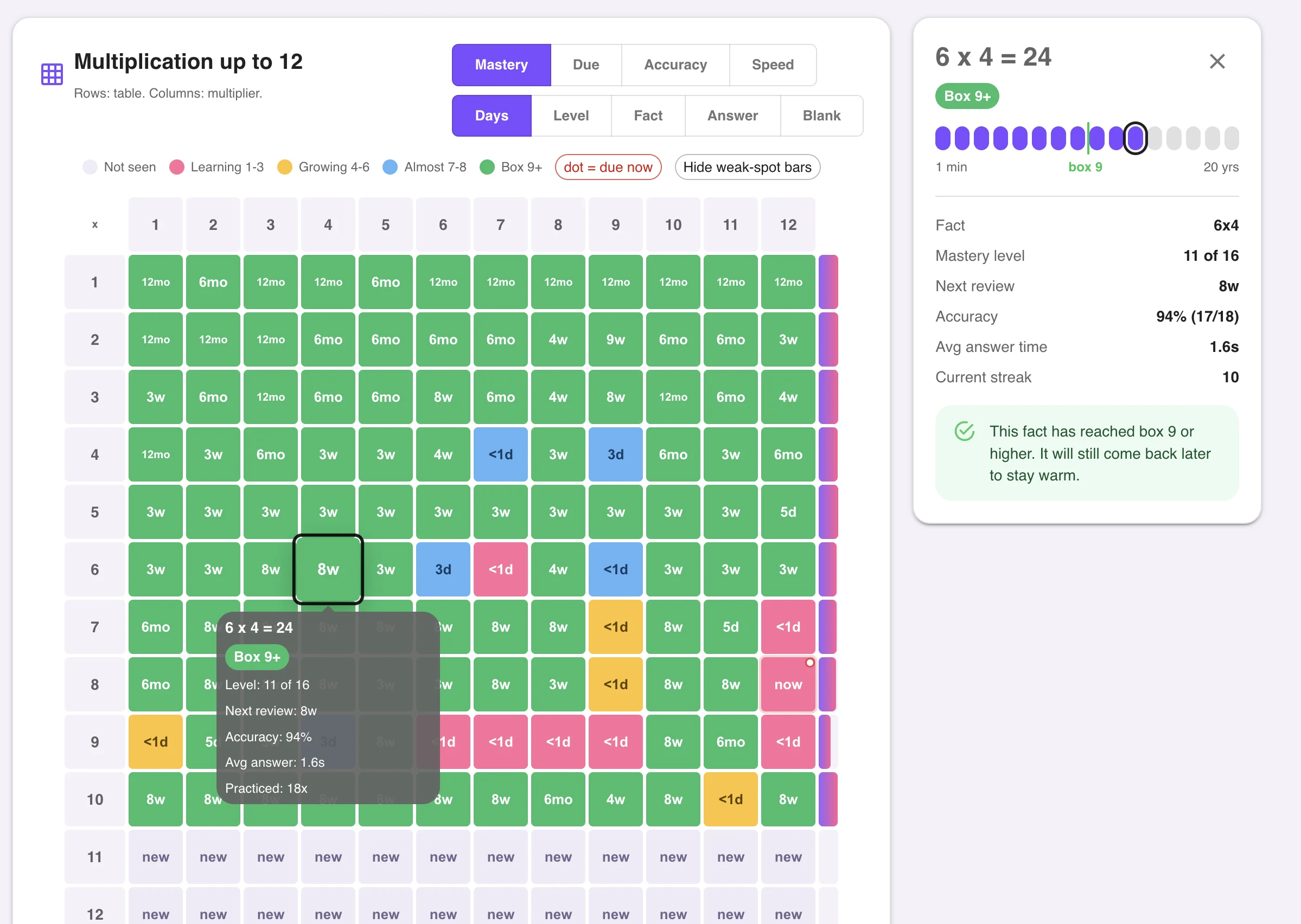
Spaced repetition only helps when the learner actually starts again tomorrow and the right facts are due. Math Builders is time-aware: it brings back slow and missed facts near the forgetting curve instead of repeating facts simply to fill a routine.
A Home Practice Loop, Not a Classroom Routine
XtraMath is great for classroom fluency routines. Math Builders is built for shorter, retention-focused practice at home.
XtraMath feels like a school fluency routine. Math Builders feels like a personal memory trainer for the facts that still slow your child down.
Math Builders is for families who want shorter, more focused spaced repetition instead of a full classroom-style daily routine. Not all spaced repetition systems are equal; the useful version is the one that schedules reviews around memory, response speed, and accuracy.
Best For, Watch Out For, Where Math Builders Fits
XtraMath
Best for: families and classrooms that want a familiar, structured, free or low-cost fact-fluency routine with reporting.
Watch out for: a strong routine still loses if the child dreads opening it.
Where Math Builders fits: use it only when the child needs a shorter repeatable session and clear weak-fact visibility.
Math Builders
Best for: parents, homeschoolers, tutors, and teachers whose current fact routine is not getting repeated.
Watch out for: it is a fact-fluency layer, not a full math curriculum or a replacement for every classroom workflow.
Where Math Builders fits: timed recall identifies automaticity, slow facts reappear through spaced repetition, and progress is saved when the learner stops.
The honest choice is not "timer or no timer." Math Builders uses timing deliberately so fast recall matters, while keeping the practice block short and recoverable.
Not All Spaced Repetition Systems Are Equal
XtraMath also uses spaced repetition, so Math Builders should not be judged as "the spaced repetition option" against a non-spaced tool. The more useful question is: which spaced fluency routine makes the best use of the minutes your child will actually repeat? A system can repeat facts and still waste time if it keeps serving the same items after the child has already answered them quickly.
Math Builders is more efficient only when the problem is daily follow-through. If a child avoids the free routine, the cheaper tool is no longer the cheaper habit. Math Builders keeps the session intentionally short, brings slow facts back, gives mastered facts less room, and saves progress when the learner stops. On light review days, the efficient answer may be a very short queue rather than forcing extra repeats. Parents, tutors, and teachers can also inspect the Most Missed Facts view instead of guessing which facts need tomorrow's attention.
Under the hood, Math Builders uses a proprietary time-aware spaced repetition scheduler with Leitner / SM-2-style spacing. It uses response speed and accuracy, not kid-rated difficulty, to decide which facts move forward, stay in review, or come back sooner, so each 2-to-5-minute session is built for efficient practice on the facts that need attention most.
If a child is already doing XtraMath consistently and the reports show steady recall progress, stay with it. If the routine is technically sound but too dreaded to restart, Math Builders is the shorter weak-fact loop to test.
Side-by-Side: What Actually Matters
| Feature | XtraMath | Math Builders |
|---|---|---|
| Best fit | Known free/low-cost daily routine for home and classroom math fact fluency | Short home, homeschool, tutoring, or small-group practice when the current routine is not getting repeated |
| Session rhythm | A consistent daily practice routine, commonly described as about 10 minutes a day | 2 to 5 minutes by default, with progress saved when the learner stops |
| Reporting and customization | Premium materials describe reports, customization, instructional resources, and support | Stats show lifetime progress, cards due, facts mastered, and Most Missed Facts for All Time and This Week |
| Weak-fact handling | Timed adaptive spaced repetition that emphasizes facts based on current strengths and weaknesses | Slow and missed facts return through time-aware spaced repetition, with response speed and weak-fact reports kept visible |
| Practice feedback | Program-managed timing, progress, and fluency status inside a familiar daily routine | Visible countdown timer plus calm, consistent answer feedback |
| Pricing fit | Free core plan with paid Premium options; check current XtraMath pricing for exact details | Parents begin with six complete individual core fact packs: full foundational practice across addition, subtraction, multiplication, and division before paying anything. Paid plans add combined practice, all-four practice, multiplication through 24, added capacity, and deeper progress detail. |
This comparison is about fit, not a claim that XtraMath lacks classroom support. Always check both products' current docs for the exact features and prices at the time you buy.
The Three Things to Test on Day One
- Run a 2-to-5-minute session
Did your kid finish without resistance? Could they have done another minute? Could they have stopped earlier?
- Check yesterday's mastered facts
Open today's session. Are any of yesterday's harder facts back in the queue? If yes, the spacing is working.
- Time the recall on a slow fact
Pick the slowest fact from yesterday. Today, did it come back faster? If yes, the practice loop is doing its job.
The Three Complaints We Hear Most
"One wrong answer undoes the whole thing." In Math Builders a miss only affects that one fact. It comes back sooner, and the rest of the session carries on. Your child never loses a level or restarts a set because of a single slip.
"My kid dreads it." Dread usually comes from being stuck in a session, not from the math. Your child can end a session at any point and keep the progress they made. Nothing punishes them for stopping.
"We are stuck on the wrong operation." You choose the facts. Addition, subtraction, multiplication, and division are all in the free core packs, so a child who needs division does not have to finish addition first.
When XtraMath Is Still the Right Call
Stay with XtraMath if the familiar daily routine, free plan, Premium reporting, or classroom workflow is working. A child who starts without a battle and shows steady recall progress does not need a switch just because Math Builders exists.
Switch or supplement only when the routine is the obstacle: the learner avoids starting, the parent has to negotiate every session, or the adult needs the slow facts surfaced quickly enough to know what to do tomorrow.
Try Math Builders Today
For the deeper method behind Math Builders, see math fact fluency and spaced repetition for math facts. Try the free multiplication practice loop first if you want a no-signup diagnostic. When you are ready to save the slow facts, start a free session. You will know inside one or two days whether the loop fits your kid. If you are still comparing apps beyond XtraMath, the multiplication app checklist for kids gives you the broader parent-facing filter.
If time pressure is the issue, the stress-free math practice and math facts without time pressure guides cover the short-session, end-session-anytime approach in detail. For a routine-specific plan, use the 5-minute math fact routine. Comparing another game-heavy multiplication product? Read the Times Tables Rock Stars alternative guide. If the specific complaint is a prompt that feels like it disappears under a timer, see the Reflex Math alternative guide.

Cost is usually the next question. The core packs are free for all four operations; see plans and what each one adds.
Frequently Asked Questions
If XtraMath is working, keep using it. Math Builders is the better fit when free or low-cost XtraMath is technically available, but your child avoids starting, fights the routine, or needs a shorter weak-fact loop that saves progress whenever practice stops.
Usually because XtraMath is credible but still not happening. A free routine that your child dreads, skips, or restarts from zero is not actually free in family time. Parents look around when they need a shorter session their kid will repeat tomorrow.
Yes. XtraMath uses spaced repetition, but the difference is efficiency. Not all SRS systems are equally efficient. Math Builders does not keep repeating facts just to fill a session; it uses response speed and accuracy to keep the queue focused on the facts that actually need work, instead of repeating the same facts over and over.
Not for everyone. XtraMath is the obvious choice when its low-cost routine is already working. Math Builders is better for the failure case: the child understands math, still freezes on facts, and needs a shorter, stop-anytime routine that shows exactly which facts are slow or missed.
XtraMath has a free plan and paid Premium options. Check XtraMath's current pricing page for exact plan details. Math Builders keeps six complete individual fact packs free, covering a full foundation across addition, subtraction, multiplication, and division before families pay anything. Teacher-issued home cards can connect each child for free. Paid plans add combined-operation practice, all-four practice, multiplication through 24, more children added without a school card, and deeper progress detail.
Yes. XtraMath Premium materials describe reporting, customization, instructional resources, and support for teachers and schools. The reason to compare is not reporting versus no reporting; it is whether the learner can keep the routine going without a daily fight at home.
Two to three minutes. Have the learner run one short Math Builders session, then ask one blunt question: would you do this again tomorrow? The useful signal is repeatability, not whether the first session feels new.