
Ebbinghaus in One Paragraph
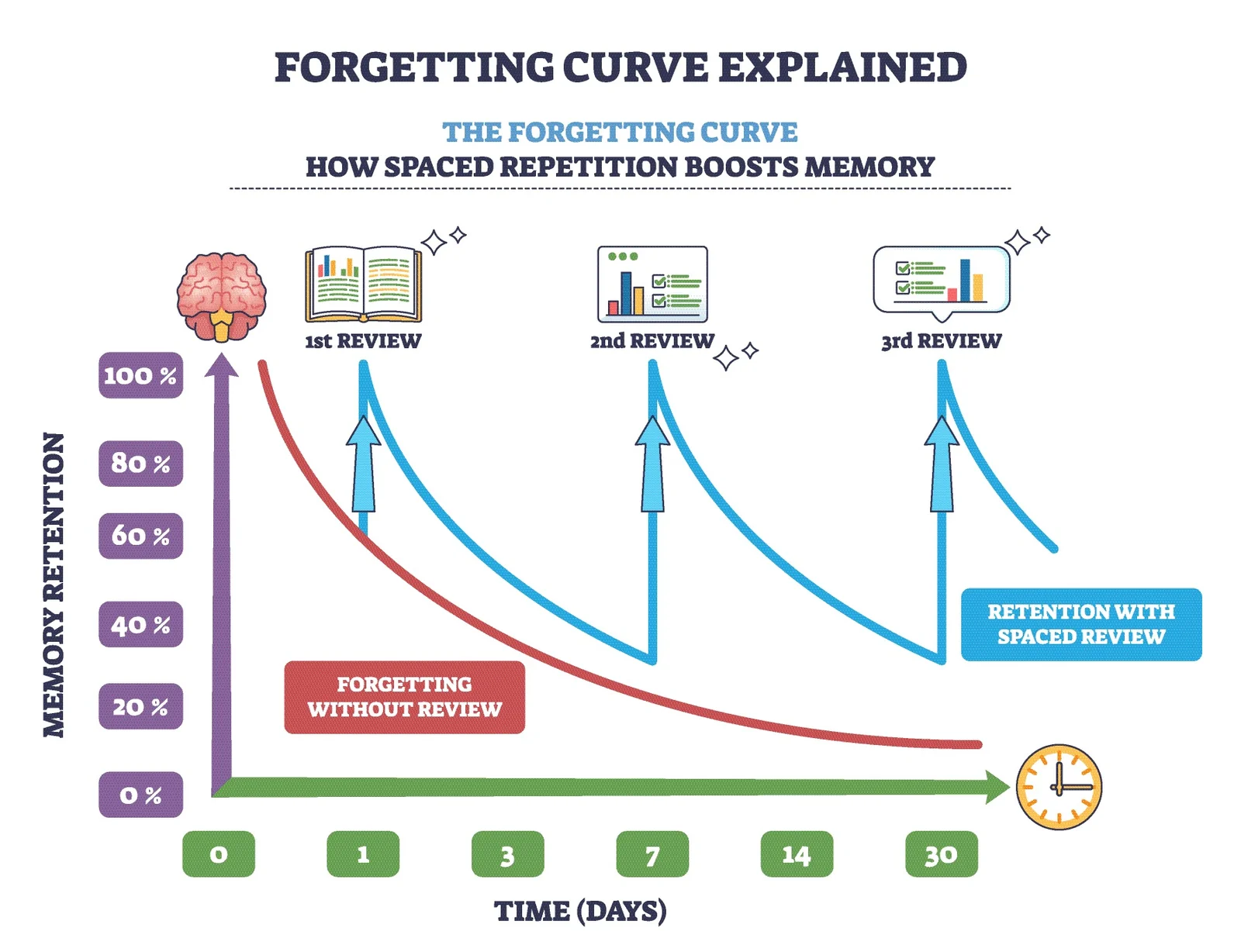
In 1885, Hermann Ebbinghaus tested himself on lists of nonsense syllables. He logged how much he could recall at different time intervals. The result was a steep early drop followed by a long tail: about 50 percent gone in an hour, 70 percent gone in a day, close to 90 percent gone in a week. The curve has been replicated in dozens of studies on real content (vocabulary, medical facts, paired associates, and yes, math) and the shape does not change.
Why Math Facts Hit the Curve Hard
Math facts have two properties that make them especially vulnerable to forgetting:
- They are arbitrary
There is no internal logic to 7 × 8 = 56. The brain cannot reconstruct it from first principles the way it can re-derive a spelling rule.
- They are atomic
Each fact is independent. Forgetting one does not flag the others, so the curve drops fact by fact without warning.
- They are rarely used in isolation
By the time a kid hits 7 × 8 inside a word problem, the working memory is already loaded with the problem context. A slow lookup costs the whole problem, not just the fact.
Estimated Retention Without Spaced Review
For a math fact a kid learned once today, the rough retention shape (based on the standard Ebbinghaus curve) is:
- 1 hour
~50% remembered
- 24 hours
~30% remembered
- 3 days
~20% remembered
- 1 week
~10% remembered
- 1 month
~5% remembered (effectively forgotten)
Cramming vs Spaced Review: A Side-by-Side
The contrast is so stark it is worth putting one column next to the other. Same kid, same facts, same total practice minutes — different distribution.
Cramming (one long session, no review)
- End of session
~100% recall. Feels like total mastery.
- Day 1 (next morning)
~50% retained.
- Day 3
~20% retained.
- Week 1
~10% retained.
- Month 1
~5% retained. The session might as well not have happened.
Spaced review (2 to 5 minutes/day, SRS schedule)
- End of first session
~80% recall. Slightly lower than cramming on day 0.
- Day 1 (after review #1)
~85% retained.
- Day 3 (after review #2)
~90% retained.
- Week 1 (after review #3)
~92% retained.
- Month 1 (after reviews #4 and #5)
~90% retained. Almost all of it still there.
Cramming wins the first 60 minutes and loses every interval after that. Spaced practice gives up a little on day 0 and holds 18x more memory by the end of the month. That gap is the entire reason a 2-to-5-minute daily routine outperforms a 30-minute weekly worksheet.
What Each Review Buys You
One successful retrieval at the right interval roughly doubles how long the fact survives. With three reviews timed correctly, the same fact that would have been 5 percent retained at 1 month is over 90 percent retained.
Not all spaced repetition systems are equal. A weak system just spaces reviews apart. An efficient one watches the forgetting curve, response speed, and misses so it can bring back the right fact near the moment recall would otherwise slip.
- Review at 24 hours
Retention at 1 week jumps from ~10% to ~60%
- Review at 3 days
Retention at 1 month jumps from ~5% to ~70%
- Review at 7 days
Retention at 1 month climbs to ~85%
- Review at 14 days
Retention at 3 months climbs to ~90%
That is the entire spaced repetition schedule, derived directly from the curve. Read spaced repetition for math facts for the implementation details.
The Summer Slide Connection
Summer slide is the same curve over a longer interval. Two and a half months with zero retrieval pushes every fact deep into the tail of the curve. The kid does not lose all their math — the durable, automatic stuff is fine — but the fluent-but-not-yet-automatic facts disappear. That is why September is full of review weeks.
A 2-to-5-minute daily session through the summer keeps the curve flat. No new content; just enough retrieval to prevent the slide. See 5-minute math practice for the routine.
Put the Curve to Work
Spaced repetition is not a productivity hack, and it is not equal just because a product says "SRS." It is the engineered response to a memory curve we have measured for over a century. For the comparison with traditional drills see spaced repetition vs traditional math drills. For the Anki / SM-2 framing see Anki-style multiplication practice, or jump straight to the under-3-second method in how to build math automaticity. To start a session, open practice.
Frequently Asked Questions
The forgetting curve is the rate at which newly learned information leaks out of memory if it is never reviewed. Hermann Ebbinghaus mapped it in 1885: roughly 50% gone in an hour, 70% gone in a day, 90% gone in a week. Each successful review flattens the curve for the next interval.
Yes — and arguably more directly than any other content type. Math facts are short, atomic, and recallable in under a second when fully memorized, which is exactly the shape Ebbinghaus tested with. The curve is why a kid who "knew" their 7s on Friday cannot find them on Monday.
By reviewing each fact at the moment before forgetting. Each successful retrieval at that boundary doubles the next retention interval. That is the entire mechanism behind efficient spaced repetition, and it is why not all SRS systems are equal.
For a brand-new fact that was learned once: about 50% gone overnight, 80% gone in 3 days, 95% gone in two weeks. With a single well-timed review at 24 hours that 95% drops to about 40%. With three well-timed reviews (1 day, 3 days, 7 days) it drops to under 10% at the one-month mark.
Closely related. Summer slide is the multi-month version of the same curve: no retrieval over the summer means the gap is too wide for the existing memory to survive. Kids return to school in September with 4 to 6 weeks of fact recall to rebuild. Daily 2-to-5-minute sessions over the summer prevent it.