
Build Your Worksheet
1. Pick one to four fact groups
Within 10: Sums up to 10 — the facts a child owns before the teens.
2. Choose a style
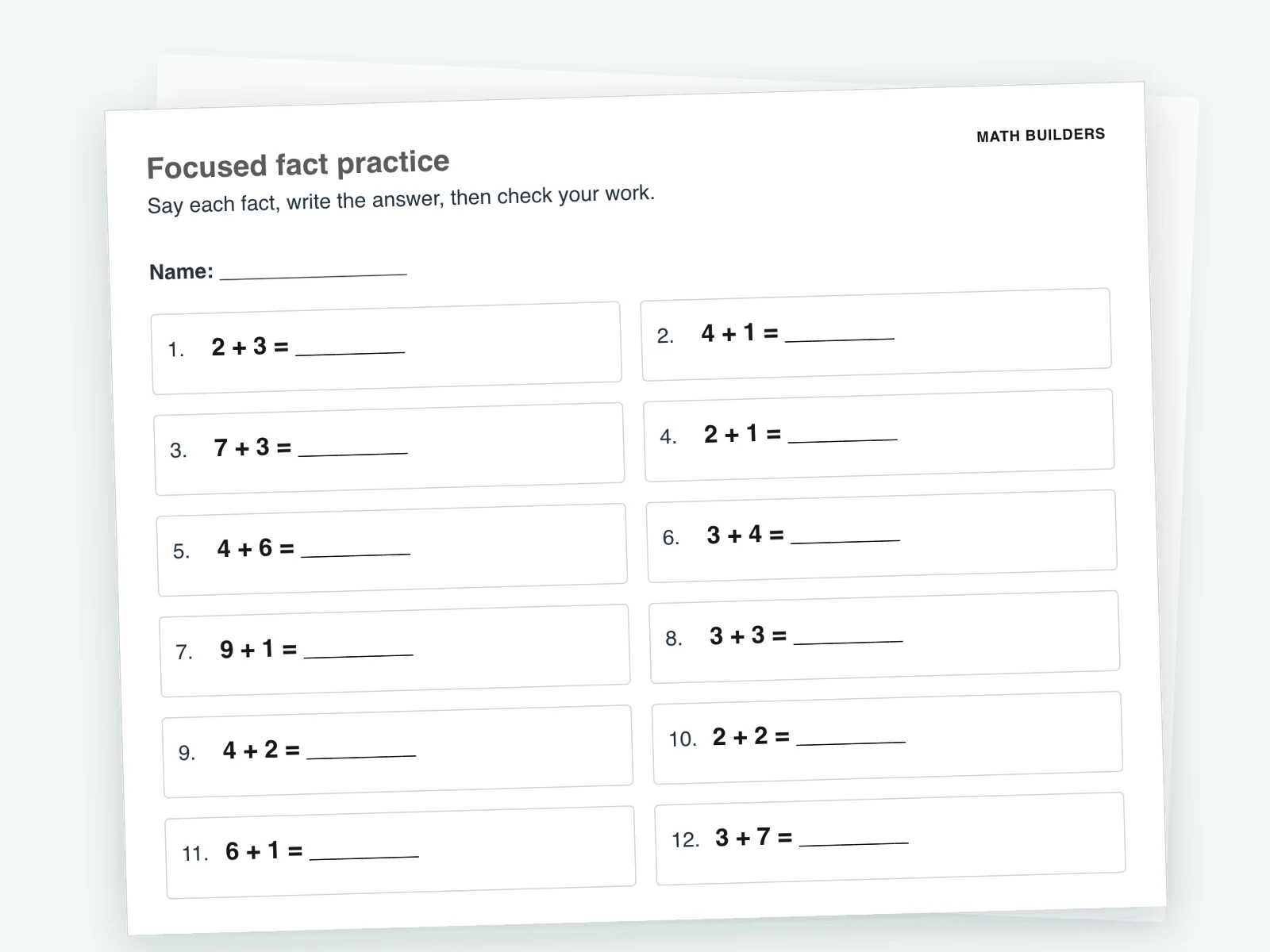
Focused fact practice
Say each fact, write the answer, then check your work.
Name: ________________
1.
2 + 3 = ________
2.
4 + 1 = ________
3.
7 + 3 = ________
4.
2 + 1 = ________
5.
4 + 6 = ________
6.
3 + 4 = ________
7.
9 + 1 = ________
8.
3 + 3 = ________
9.
4 + 2 = ________
10.
2 + 2 = ________
11.
6 + 1 = ________
12.
3 + 7 = ________
Answer key
Check after the worksheet is complete.
Name: ________________
1.
2 + 3 = 5
2.
4 + 1 = 5
3.
7 + 3 = 10
4.
2 + 1 = 3
5.
4 + 6 = 10
6.
3 + 4 = 7
7.
9 + 1 = 10
8.
3 + 3 = 6
9.
4 + 2 = 6
10.
2 + 2 = 4
11.
6 + 1 = 7
12.
3 + 7 = 10
Coloring Sheets for the Same Addition Facts
A color-by-number sheet asks for the same recall and holds a reluctant child longer. Each one prints with its own answer key:
How to Use an Addition Worksheet Well
- Start inside one group. A sheet that mixes "Within 5" with "Within 20" asks a child to switch strategies every other problem, and switching is what they are still slow at.
- Watch the fingers, not the clock. A child who counts up from the larger addend will get every answer right and still not know the fact. Circle those; a correct answer that took counting is the thing to fix.
- Move the circled facts into retrieval practice. Paper shows you which sums are still being counted; 2 to 5 minutes of spaced repetition is what actually speeds them up.
- Add "Making 10" before "Within 20". A child who knows 6 + 4 instantly can turn 6 + 7 into 10 + 3. Without that, the teen sums stay a counting exercise however many sheets they finish.
More Free Addition and Subtraction Tools
Subtraction worksheets — the same groups read backwards, because every subtraction fact is an addition fact in reverse.
Addition and subtraction fluency guide — what counting on costs, and the order the groups are usually taught in.
Color by code generator — a coloring sheet for addition to 10 or 20, with an answer key.
All free printables — every sheet on the site in one place, by grade and operation.
Frequently Asked Questions
Right here. Pick the fact groups above, then press print. You can save the sheet as a PDF from the same box. There is no account and no email gate.
Multiplication has times tables; addition does not. Addition facts are taught in groups — sums within 10, doubles, the pairs that make 10, then sums within 20 — so those are the groups you pick from here.
Within 20, with addends from 1 to 10, there are 100 ordered facts and 55 distinct pairs. A child who knows the doubles and the pairs that make 10 already has a strategy for most of the rest.
Because the group you picked does not hold 12 facts. Making 10 has nine, and the doubles have ten. The sheet prints each fact once rather than repeating one to fill the page — a repeat is not extra practice. Pick a second group for a longer sheet.
Sums within 10 and the doubles come first, then the pairs that make 10, then the sums within 20 that cross a ten. The last group is the one that stays slow, and it is much easier once making 10 is automatic.
Yes. Print as many copies as you need. Press "Generate another version" between prints if you want each student to get a different set of problems.